Provenance Is Not About Tools. It Is About Mindset.
Author: Yauheni Kurbayeu
Published: Mar 15, 2026
Over the past months, while exploring the idea of decision provenance in software development, I noticed something interesting. Most people initially interpret the Provenance Manifesto as a proposal about new tools, new documentation standards, or new processes.
But that interpretation misses the core point.
The manifesto is not primarily about changing tools.
It is about changing how we think about knowledge, decisions, and responsibility in engineering organizations.
And that change is much harder than introducing a new system.
The Hidden Assumption of Modern Engineering.
For decades, software development has operated under a quiet assumption:
The reasoning behind systems lives inside people.
We store implementation artifacts very well:
- Code in repositories
- Tasks in issue trackers
- Documentation in knowledge bases
- Infrastructure in configuration systems
But the most important part of the system - why things were decided the way they were - usually lives somewhere else.
It lives in:
- Design meetings
- Slack threads
- Architectural discussions
- Personal memory
Over time, this reasoning slowly disappears.
- Architects change roles
- Engineers move teams
- Managers leave organizations
The system remains, but the context that created it dissolves.
For many years this limitation was tolerable. Systems evolved slowly enough that teams could often reconstruct the reasoning when needed.
The AI‑augmented era changes that dynamic dramatically.
Why the Provenance Manifesto Is About Mindset.
When people hear about the idea of capturing decisions as structured artifacts, the first reaction is often technical:
- "Should this be another documentation system?"
- "Is this just ADRs?"
- "Is this another tool we need to maintain?"
But provenance is not a documentation problem.
It is a mindset shift.
The idea is simple but powerful:
Decisions themselves must become first‑class artifacts of the system, just like:
- code
- infrastructure
- APIs
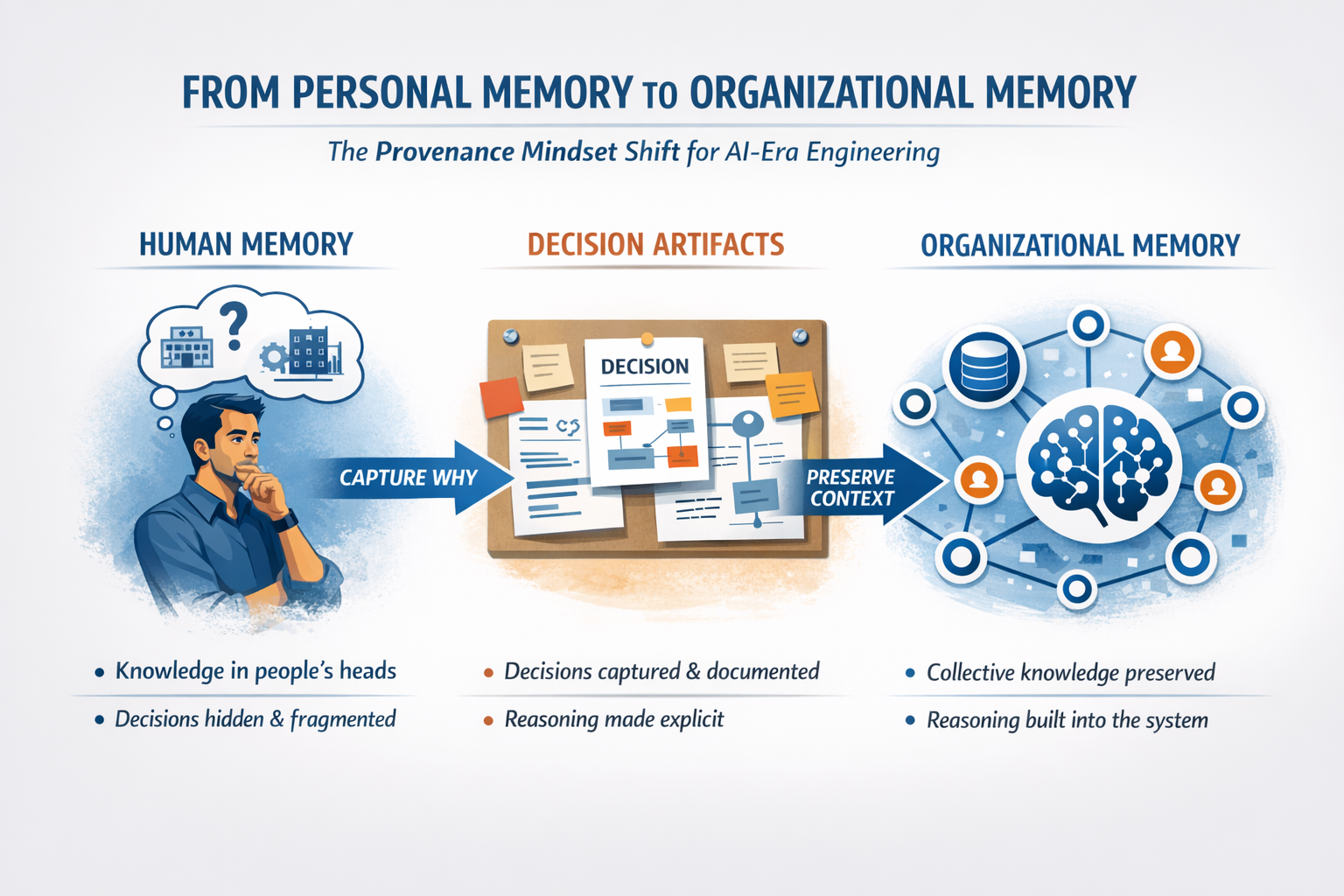
Instead of existing only in conversations or personal memory, decisions should be preserved with their context:
- the assumptions behind them
- the risks considered
- the constraints involved
- the alternatives rejected
- the outcomes they produced
This represents a fundamental change in how organizations treat knowledge.
It moves us from:
Individual Memory to Institutional Memory
And that shift challenges long‑standing habits in engineering culture.
Why People Resist Sharing Their Decisions.
Resistance to this idea is rarely about tools or process overhead.
It is usually about something deeper.
In many knowledge‑driven professions, a simple rule applies:
Context is power.
The person who remembers why a system works the way it does holds influence. They become the interpreter of past decisions. They become the source of explanations when something breaks.
In practice, this creates an invisible hierarchy based on private knowledge.
When decisions remain undocumented, the organization depends on the people who remember them.
Preserving decision provenance changes this dynamic.
When reasoning becomes part of the system itself:
- knowledge becomes accessible to everyone
- context becomes searchable
- authority becomes traceable
For some people this feels uncomfortable, because it removes the advantage of holding context privately.
This is one of the reasons why decision capture has historically been inconsistent across organizations.
It is not that teams cannot document decisions.
It is that culturally, they often do not.
Why the AI Shift Makes This Problem Urgent.
Artificial intelligence is accelerating software creation.
AI agents can generate code faster than teams can reason about the consequences.
As a result, the real bottleneck in software development is shifting.
It is no longer writing code. It is understanding the decisions behind the system.
Without preserved decision context:
- systems become harder to evolve
- architectural trade‑offs disappear
- new engineers cannot reconstruct the past
- AI agents lack the reasoning context needed to act safely
The faster systems evolve, the more dangerous context loss becomes.
This is why provenance is not just an intellectual exercise.
It is becoming a structural requirement for AI‑augmented development.
What We Should Start Doing Right Now.
The good news is that adopting the provenance mindset does not require waiting for new platforms or complex infrastructure.
Organizations can begin today by focusing on a simple principle:
Preserve decisions wherever AI participates in the development process.
In practice this means capturing the reasoning behind work that involves:
- AI assistance
- automation
- agent‑driven execution
Examples include:
- When AI generates an implementation plan → preserve the execution plan
- When architectural alternatives are evaluated → preserve the trade‑off discussion
- When assumptions influence design → preserve assumptions and constraints
- When decisions are made → record the decision and the reasoning behind it
These artifacts can come from many sources:
- meeting transcripts
- architecture reviews
- AI execution plans
- follow‑up summaries
- architecture decision records
The important change is not the format.
The important change is the intent to preserve reasoning as part of the system.
Keeping Humans in the Loop.
Capturing decisions should not be a fully automated process.
AI can help extract structure from conversations, documents, and discussions. But humans remain essential for validating meaning.
A practical workflow may look like this:
- Conversations and meetings are captured
- AI extracts candidate decisions, assumptions, and risks
- A responsible person reviews and confirms the structure
- The validated decision becomes part of system memory
This keeps human understanding in the loop while allowing AI to scale the capture process.
The Beginning of Organizational Memory.
The Provenance Manifesto ultimately proposes something simple but powerful.
Organizations should treat reasoning the same way they treat code.
- Code describes what the system does.
- Decision provenance explains why the system became what it is.
In the AI‑augmented world, both are essential.
Because when systems evolve faster than humans can remember them, the organizations that survive will be the ones that build memory into the system itself.