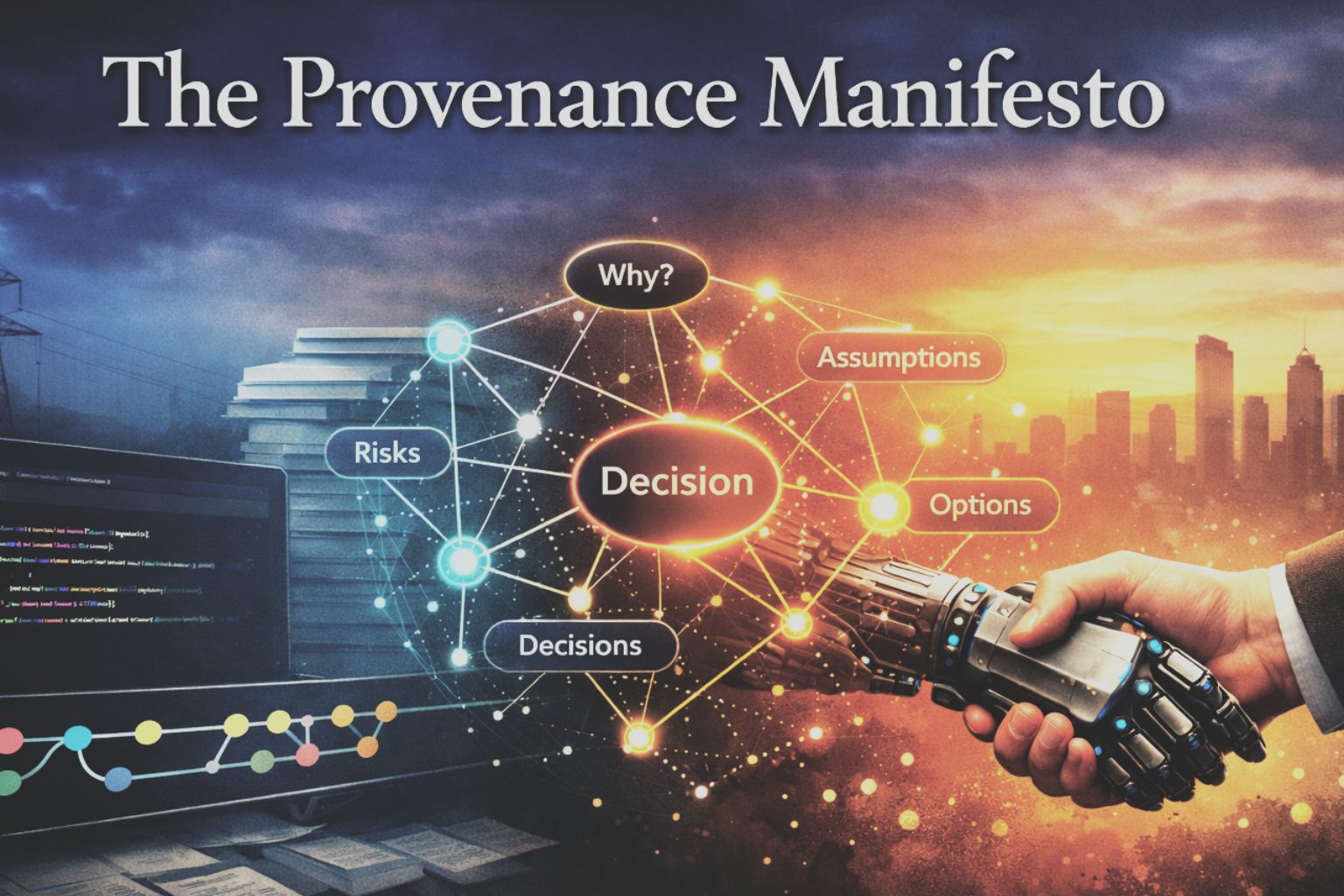
The Day the Provenance Manifesto was Born.
Author: Yauheni Kurbayeu
Published: March 8, 2026
LinkedIn
Over the past months, I have been exploring a question that initially appeared technical but gradually became much broader.
Why does software development have almost no memory of its own decisions?
This question led to a series of articles in which I examined the problem from several angles.
First, I looked at the illusion that humans remember everything about the systems they build. In reality, teams change, architects move on, and the reasoning behind systems quietly disappears while the systems themselves remain.
Then I explored whether modern AI retrieval approaches could help preserve that reasoning. Vector search and RAG looked promising at first, but the deeper the analysis went, the clearer it became that similarity search alone cannot reconstruct the chain of assumptions, risks, constraints, and trade-offs behind real engineering decisions.
That realization led to the idea of incremental graph-based provenance memory, a way to preserve not just documents, but the relationships between decisions and the context that produced them.
At some point, the discussion stopped being purely technical.
The real issue turned out to be something deeper: software engineering has never treated decisions as first-class artifacts.
We version code, store commits, and reproduce builds.
But the reasoning that shapes systems disappears almost immediately.
As AI accelerates how fast software can be produced, this gap becomes even more dangerous.
Which is why today I'm publishing the Provenance Manifesto.
- AI can accelerate execution dramatically.
- Provenance preserves accountability.
A few additional thoughts behind the manifesto
During this research, it became clear that the real challenge is not documentation or knowledge retrieval. The challenge is that software engineering has never established a system of record for decisions.
Every architecture, product behavior, operational process, and incident response originates from decisions. Yet those decisions rarely survive longer than the teams that made them.
Organizations inherit systems, but not the reasoning behind them.
The Provenance Manifesto proposes a simple shift:
- Decisions should carry context.
- They should evolve but never disappear.
- They should be queryable.
- They should have ownership.
And as AI becomes an active participant in development, it should operate within a transparent framework of decision governance.
Publishing the manifesto is not the conclusion of the research.
In many ways, it is the beginning.
If this topic resonates with you, whether you work on architecture, knowledge systems, AI tooling, or engineering leadership, I would genuinely value your perspective.
Contribute
Your contribution is greatly appreciated:
https://github.com/yauhenikurbayeu/ProvenanceManifesto/blob/main/README.md