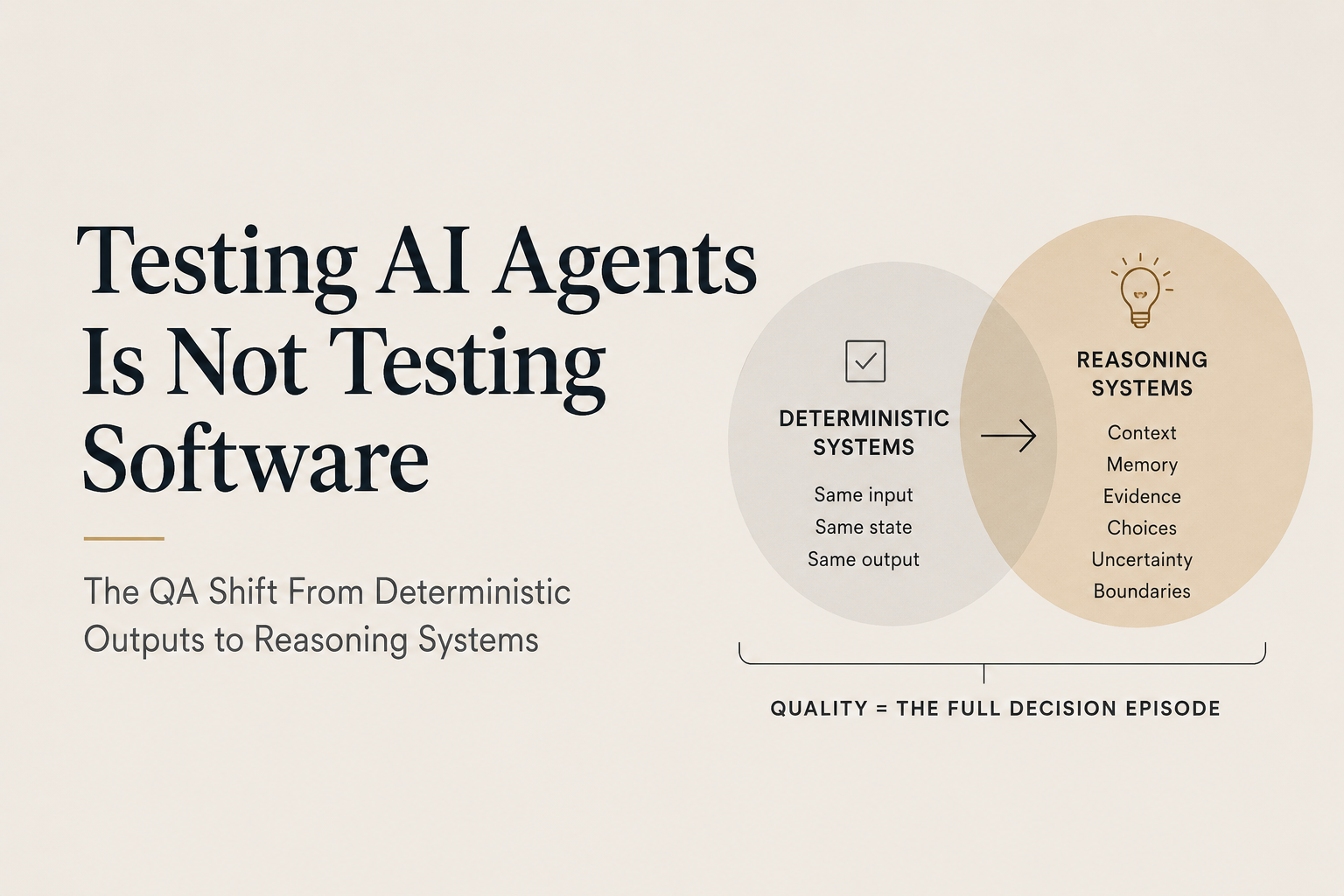
Testing AI Agents Is Not Testing Software
Author: Yauheni Kurbayeu
Published: May 20, 2026
For decades, software quality assurance relied on one comforting assumption:
given the same input and the same system state, a correct system should produce the same output.
That assumption shaped almost everything in modern engineering.
We built unit tests around deterministic functions. We validated APIs against expected responses. We compared outputs against snapshots and treated mismatch as failure. The entire discipline of QA evolved around predictability.
And for traditional systems, that model still works remarkably well.
Payment calculations should remain exact. Permission checks should stay deterministic. Data migrations should produce the same result every time. Safety boundaries should not improvise.
But AI agents introduced a different kind of system.
Not just a system that generates text, but a system that participates in reasoning.
That distinction changes the shape of failure completely.
An agent may receive the same prompt twice and produce two different but still defensible outcomes. It may retrieve different memory, prioritize different evidence, choose a different tool chain, or decide that uncertainty is high enough to escalate instead of acting autonomously.
The dangerous part is not that the wording changes.
The dangerous part is this:
an AI agent can produce the correct answer for the wrong reason.
Traditional QA frameworks are surprisingly weak at detecting that kind of failure.
A generated response may look coherent, persuasive, and structurally valid while the reasoning underneath quietly drifted outside acceptable boundaries. The model may rely on stale evidence, ignore an escalation rule, import the wrong prior decision, or invent operational confidence that was never actually justified.
And if the final sentence still looks reasonable, many current testing approaches will happily pass the run.
That is the real shift happening right now.
The question is no longer only:
Did the system produce the expected output?
It increasingly becomes:
Did the system reason within acceptable boundaries?
That changes QA from output validation into something much closer to behavioral governance.
The Shift From Functions to Decision Processes
One of the biggest mistakes teams are making right now is testing AI agents as if they were still ordinary software functions.
But an agent is not just a function anymore.
It sees context. It retrieves memory. It interprets signals. It evaluates trade-offs. It chooses between alternatives. Sometimes it refuses to act. Sometimes it escalates uncertainty to a human. Sometimes it quietly carries assumptions from one decision into another.
In other words, the system is no longer only executing logic.
It is participating in decisions.
And once a system starts participating in decisions, the final output stops being the only thing that matters.
The reasoning path itself becomes part of the system contract.
That is why traditional “input → expected output” testing starts breaking down in agentic systems. Two outputs may look equally plausible while one of them is operationally unsafe because the path used to reach it violated evidence discipline, governance rules, or memory boundaries.
This is where the concept of a “decision episode” becomes useful.
Instead of testing only the final response, we start testing the full reasoning episode around it. The instruction matters. The available evidence matters. The memory retrieved before the decision matters. The assumptions matter. The rejected alternatives matter. Even the uncertainty representation matters.
A deterministic QA test usually asks:
Input: X
Expected output: Y
A reasoning-oriented QA test asks something very different:
Instruction: choose a deployment strategy

Constraints:
- minimize blast radius
- verification is mandatory

Evidence:
- deployment telemetry
- incident history
- rollout policy

Expected behavior:
- no invented evidence
- escalation remains available
- verification cannot be skipped
- final recommendation stays inside governance boundaries
The final answer still matters, of course.
But it is no longer enough.
Memory Changes the Nature of Testing
This becomes especially visible once agents start working with memory.
Modern AI systems increasingly retrieve prior decisions, embeddings, tickets, runbooks, summaries, or graph-based context before making new recommendations. At first glance this feels powerful because the system appears more informed and more consistent over time.
But memory introduces an entirely new failure mode.
The real problem is not whether the agent can retrieve prior context.
The real problem is whether the agent knows when that prior context should no longer be trusted.
A stale prior can quietly contaminate an entire reasoning chain while still sounding extremely convincing. A policy may have changed. Ownership may have shifted. Constraints may no longer apply. Yet the retrieved decision still “looks similar enough” to influence the new one.
That is why mature reasoning systems need explicit reuse boundaries instead of blind historical similarity.
Without those boundaries, memory becomes something dangerous:
bias with a search interface.
And that is one of the most important governance problems emerging in AI systems today.
Why Behavioral Contracts Matter More Than Sentences
Another major shift is that generated text itself becomes a weak testing surface.
A paragraph can sound intelligent while hiding a broken process underneath. This is why strong AI QA increasingly moves away from sentence comparison and toward behavioral contracts.
The important questions become operational rather than linguistic.
Was the required evidence actually available? Did the system acknowledge uncertainty honestly? Did escalation remain possible? Did the workflow stay inside governance constraints? Were missing signals represented as missing rather than silently invented?
Those are much stronger indicators of trustworthy reasoning than whether the wording remained stable between runs.
One of the clearest quality signals an agent can produce is actually a refusal:
Not enough evidence exists to support this conclusion.That is not weakness.
That is disciplined reasoning.
And disciplined reasoning is exactly what many current AI systems still struggle to preserve under pressure.
The Invisible Complexity of Multi-Agent Systems
The complexity increases again once orchestration enters the picture.
Multi-agent systems often fail not inside one model, but between models.
One agent retrieves memory. Another executes a task. Another validates the output. Another logs the decision. Somewhere between those handoffs assumptions get dropped, evidence gets reshaped, or accountability becomes impossible to reconstruct afterward.
This is why observability in agentic systems cannot stop at outputs and latency graphs.
Organizations increasingly need traceability around reasoning flow itself. Which agent made the decision? Which prior decisions were reused? Which session produced the artifact? Where did escalation happen? Who approved the override?
Without that visibility, “multi-agent architecture” risks becoming mostly a marketing label rather than an auditable operational system.
From QA to Governance
What makes this even more complicated is that many failures only become visible after the decision was already made.
The output may initially look acceptable. But over time patterns begin to drift. The system starts overusing fallback behavior. Escalation frequency changes. Old priors get reused in situations where they no longer fit. Decisions slowly diverge from canonical policy while still appearing individually reasonable.
These are not deterministic software bugs.
They are reasoning drift signals.
And they require a very different operational mindset.
Traditional QA was largely about proving that the implementation matched the specification. Reasoning QA increasingly becomes about proving that the system can operate within governed decision boundaries even as context changes over time.
That is a much deeper challenge.
Because now we are not only testing code.
We are testing evidence discipline, uncertainty handling, memory reuse, escalation behavior, authority boundaries, and the system’s ability to remain governable under ambiguity.
In other words, QA is slowly evolving into part of the governance layer itself.
Not governance as bureaucracy. Governance as operational control over reasoning systems.
Final Thought
The industry still talks about AI reliability mostly in terms of hallucinations, latency, or benchmark quality.
But the harder problem is emerging somewhere else.
The harder problem is whether organizations can still understand, trust, challenge, and intervene in decisions once reasoning itself becomes partially automated.
That is why the future of AI QA probably does not look like stronger snapshot testing.
It looks more like accountable reasoning systems with auditable decision traces, explicit evidence boundaries, controlled memory reuse, observable orchestration, and intervention points designed directly into the flow.
Because once systems start participating in operational decisions, deterministic QA assumptions stop being enough.
And the real question quietly changes from:
“Did the system say the right thing?”
to something much more important:
“Can we trust how it arrived there?”