How Should Intellectual Capital Be Assessed In The Context Of Artificial Intelligence Increasingly Replacing Human Roles?
Author: Yauheni Kurbayeu
Published: Feb 16, 2026
LinkedIn
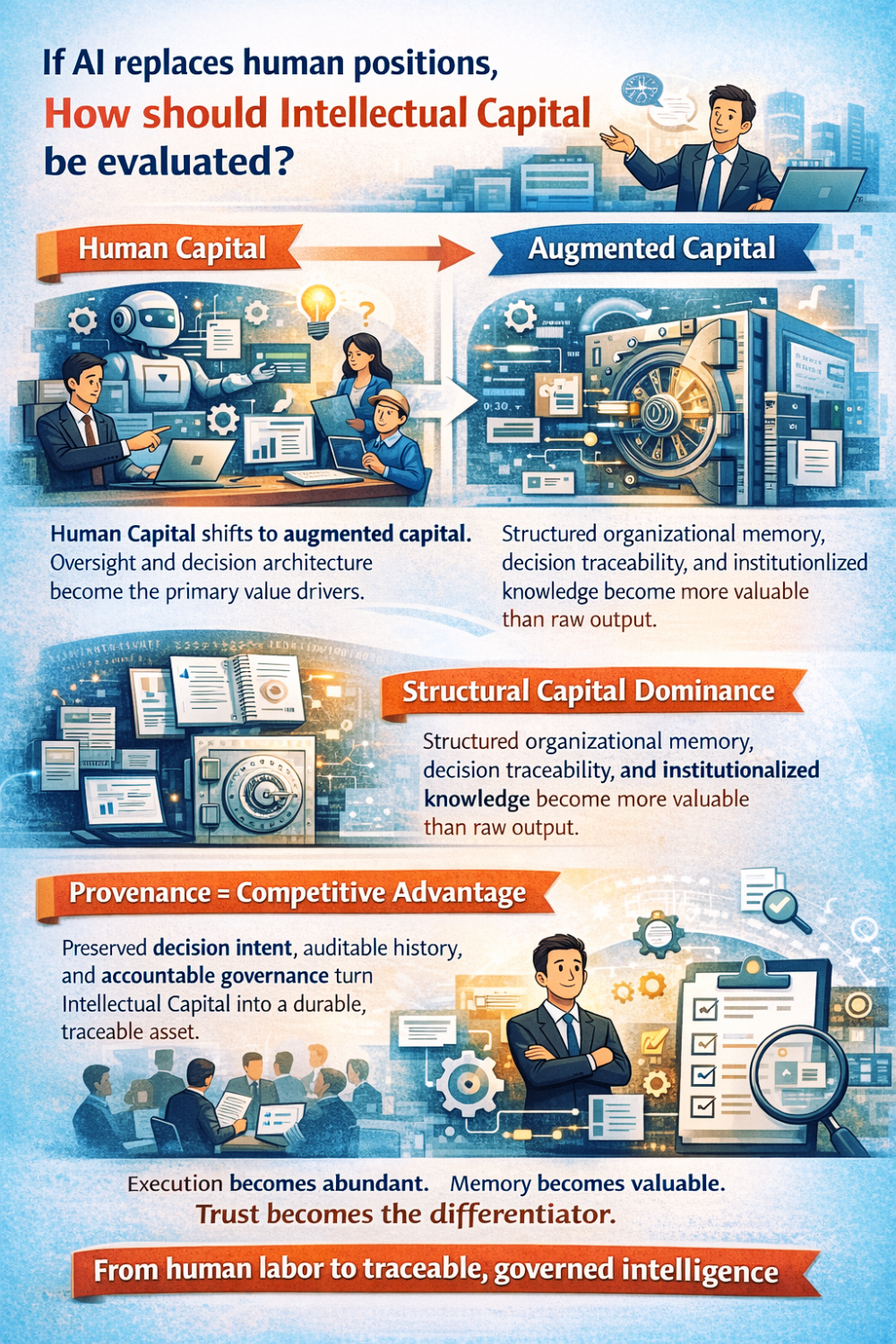
For decades, especially in IT services and SaaS, Intellectual Capital was relatively straightforward to understand and measure. The stronger your engineers, architects, delivery managers, and domain experts, the more valuable your organization was considered.
The valuation methodology was closely tied to the quality of the workforce, the structure of the seniority pyramid, utilization rates, and the concentration of critical expertise among key individuals.
Human capital was the asset.
But if AI materially replaces a significant portion of execution roles, then the question becomes uncomfortable but necessary: What exactly are we valuing now?
AI already writes code, drafts documentation, proposes architecture, generates test cases, analyzes logs, and supports decision-making. Execution is becoming cheaper and more scalable. And when something becomes abundant, it stops being the premium differentiator.
Intellectual Capital must be evaluated differently.
Human capital becomes “Augmented Capital”
Human capital does not disappear, but its nature changes. In an AI-augmented organization, the most valuable people are no longer simply the fastest coders or the most productive contributors in terms of raw output. They are the ones who can define constraints, evaluate trade-offs, govern AI outputs, manage systemic risk, and make accountable decisions in ambiguous environments.
Value shifts from “people × hours × experience” toward “people × leverage × decision quality”.
While the volume of human expertise may decrease, its strategic significance increases. The emphasis shifts from execution to oversight, from production to orchestration, and from operational tasks to governance. In essence, human capital evolves into augmented capital, enhanced by AI, yet remains responsible for providing meaning and ensuring accountability.
Structural capital becomes dominant.
At the same time, structural capital becomes dramatically more important. Structural capital means your processes, data, governance models, architectural patterns, institutional memory, and the way decisions are captured and made reusable.
AI can generate output, but it cannot reconstruct intent that was never documented. It cannot explain why a trade-off was accepted six months ago if that reasoning lived only in someone’s head or in a Slack thread long forgotten. If an organization cannot answer why a certain architecture was chosen, why a deadline was moved, or why a specific risk was consciously accepted, then AI will only accelerate confusion.
Velocity without memory increases entropy.
So in an AI-augmented world, structural capital, especially decision traceability and institutional memory, becomes more valuable than raw execution capacity.
This is where Provenance becomes strategic.
Provenance is not about adding bureaucracy or writing more documents. It is about systematically capturing intent, assumptions, constraints, alternatives, trade-offs, and ownership at the moment decisions are made, and turning that into structured, queryable memory.
Instead of “someone remembers why we did this,” you have a traceable decision record with context, risk assessment, and accountable ownership. That transforms tacit human knowledge into structural capital. It reduces dependency on specific individuals, protects the organization during leadership changes, and creates a compounding knowledge asset that competitors cannot copy.
In an AI-driven environment, where execution is cheap and fast, memory becomes scarce, and trust becomes monetizable. Investors and clients will increasingly care about governance maturity, auditability, and decision traceability, because these directly reduce operational and compliance risk.
TL;DR
AI does not eliminate Intellectual Capital. It reorganizes it.
From people who remember - to systems that preserve meaning.
The companies that survive and grow in the AI-augmented world will not be those who simply reduce headcount fastest. They will be the ones who convert human knowledge into structured, governed, traceable capital.
Execution will be abundant.
Memory will be expensive.
And Provenance will be a competitive advantage.
If this resonates with you, I would be genuinely interested to learn:
How is your organization safeguarding its intellectual capital in the era of AI?