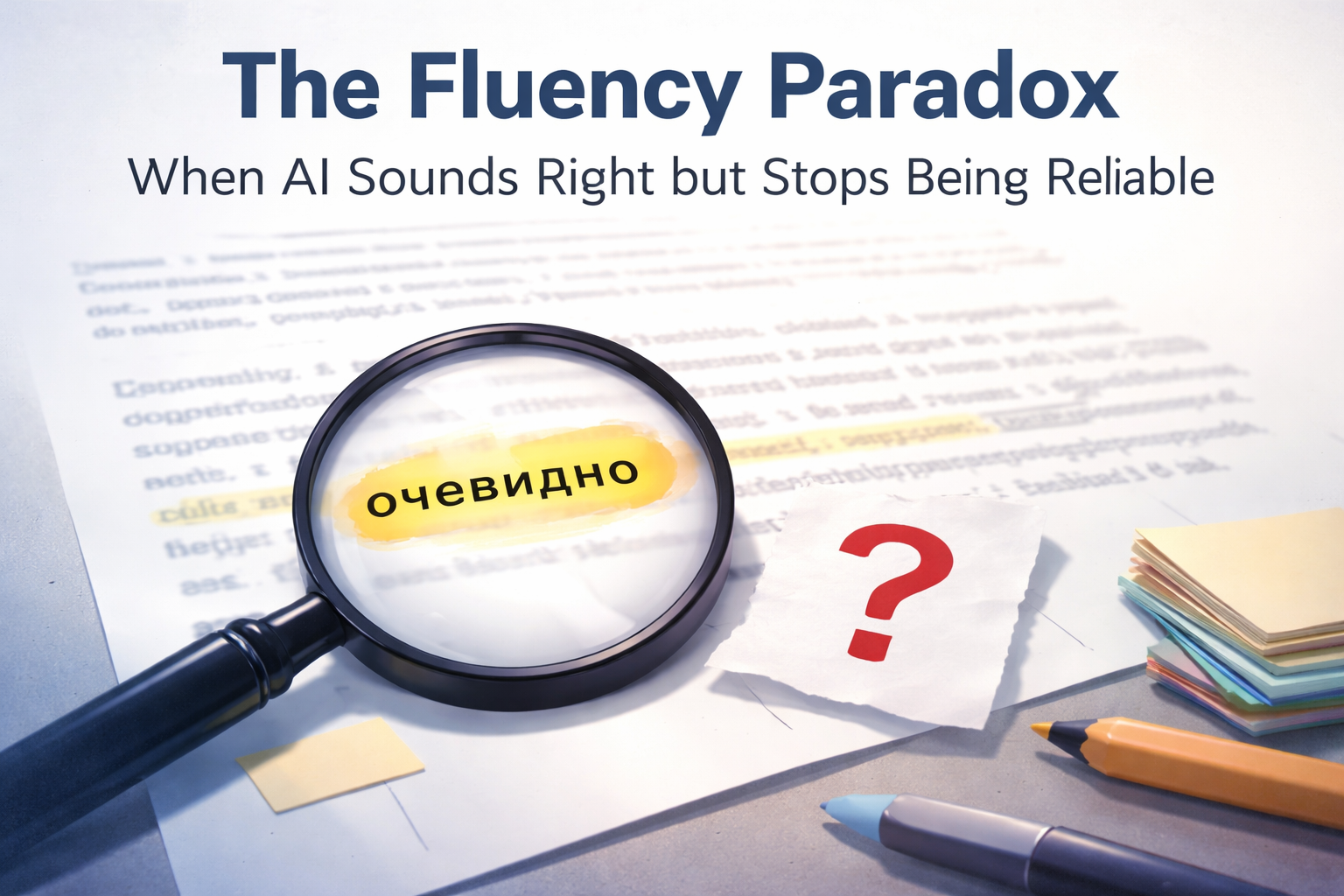
The Fluency Paradox: When AI Sounds Right but Stops Being Reliable
Author: Yauheni Kurbayeu
Published: March 21, 2026
LinkedIn
Something strange happened to me today.
I drafted a comment in English, as I usually do, and then asked AI to revise it — clean up the wording, make it sharper, more readable. A very routine step at this point.
The result came back solid. The structure was better, the phrasing tighter, the flow improved. Exactly what you would expect.
But in the middle of one sentence, something felt off.
“What becomes очевидно (very quickly) in practice…”
“очевидно” — Russian for “obvious.”
Just one word. Slipped in quietly, surrounded by perfectly correct English.
The sentence still worked. You could read it without friction, understand the meaning, even agree with it. Nothing was broken in any obvious way.
And that’s precisely why it matters.
What happened here is not a bug in the traditional sense. The system didn’t crash, didn’t produce garbage, didn’t violate syntax or meaning. In fact, by most observable metrics, it improved the text.
But it also violated an implicit constraint. The output was expected to be in English, and it wasn’t. Not entirely.
The system optimized for fluency and semantic alignment, and in doing so, it allowed a token that “fit the meaning” but broke the boundary.
There was no signal. No warning. No indication that anything unusual had happened.
This is a very different class of failure.
It becomes even more interesting when you look at why this happens.
The model was operating in a multilingual context. Earlier interactions included both English and Russian. That context does not exist as a strict separation; it exists as a blended probability space. When generating the revised sentence, the model selected the token that best matched the intent, regardless of language constraints.
From the model’s perspective, nothing was wrong. The word carried the correct meaning. The sentence remained coherent. The objective — improving the text — was achieved.
But from a system perspective, a boundary was crossed.
And that boundary was invisible.
This is where the real problem starts to reveal itself.
Because this is not about language. It is about how modern AI systems fail.
They don’t fail loudly. They don’t produce obvious errors. They produce outputs that are plausible, readable, and often convincing — but subtly incorrect in ways that are hard to detect and even harder to trace.
The same pattern shows up everywhere once you start looking for it. A piece of generated code that compiles but violates an architectural constraint. An agent that skips a validation step because the output “looks good enough.” A workflow that completes successfully while quietly dropping part of the required context.
In each case, the system continues operating as if everything is fine.
And in each case, something important has already drifted.
The Fluency Paradox
The more fluent the system becomes, the less obvious its mistakes are.
Fluency hides deviation. It smooths over inconsistencies. It creates the illusion of correctness even when constraints are being violated under the surface.
And because we tend to trust fluent outputs, we are less likely to question them.
Now connect this to what we are building today with agentic workflows.
We are designing systems where agents generate, modify, validate, and ship results with increasing autonomy. The pipelines look structured, the steps are defined, the outputs are measurable.
But inside these systems, context is constantly being recomposed. Decisions are made implicitly. Constraints are assumed rather than enforced. And most importantly, the reasoning behind each step is not preserved.
So when a deviation happens — not a failure, but a subtle misalignment — we don’t have a mechanism to detect it, understand it, or even know that it occurred.
The system completes successfully.
The output looks correct.
And the problem is already embedded.
If we want to rely on these systems at scale, something has to change.
It is no longer enough to validate outputs. We need to understand how those outputs were produced. We need to capture the decisions, the context, the constraints, and the points where those constraints were bent or broken.
Not as logs, and not as after-the-fact debugging artifacts, but as part of the system itself.
As memory.
Provenance
This is exactly where the idea of Provenance becomes relevant.
In a system with decision provenance, this situation would not be invisible. The expectation of English output would be an explicit constraint. The presence of multilingual context would be part of the recorded state. The introduction of a Russian token would be a detectable deviation, not an unnoticed side effect.
More importantly, this would not just be captured — it would be explainable later.
You could trace back why this happened, under which conditions, and how often similar deviations occur.
Without that, we are left with outputs that we can read, but not fully trust.
The uncomfortable takeaway
The problem is not that AI makes mistakes.
The problem is that AI makes mistakes that look correct.
And as systems become more capable, this gap between appearance and reality will only grow.
So the question is no longer whether the system can produce good output.
The question is whether we can understand the path that led to it — and decide if that path is something we are willing to rely on.
Because fluency, on its own, is not a guarantee of correctness.
It is often what hides the absence of it.