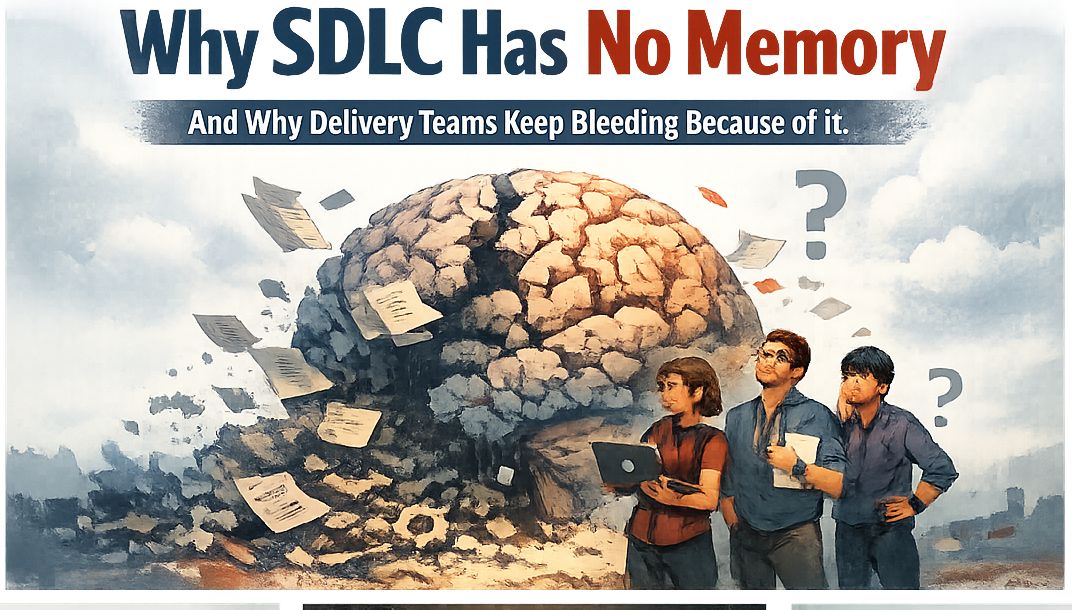
Why SDLC has no memory (and why delivery teams keep paying for it)
Author: Yauheni Kurbayeu
Published: Jan 1, 2026
LinkedIn
Let me describe a scene you probably recognize.
A project. Six months in. Maybe twelve. Someone asks: “Why are we doing it this way?” Silence. Someone says: “I think it was in the original scope.” Someone else: “No, it was added later.” The architect: “It was a tradeoff… but I don’t remember which one.” Confluence is opened. Dozens of pages. Half outdated. Half contradictory. The SOW is in email. The proposal is somewhere. The RFP is gone. Two people who actually knew the story already left the company.
So the team does what teams always do:
- They guess.
- They decide again.
- They move on.
And nobody even calls this a problem anymore.
The disease: Context Amnesia
Software delivery organizations suffer from Context Amnesia.
We constantly lose:
- Why something was built
- What problem are we solving
- What was promised vs what was “just added”
- Why certain decisions were made
This happens everywhere:
- Discovery and Presales
- Presales to Delivery handover
- Architecture and design
- Implementation
- Change requests
- People leaving
- Support, incidents, audits
- And finally… the rewrite
We don’t lose context because people are careless. We lose it because SDLC has no memory.
The real cost
This is not theoretical:
- Rework
- Free work
- Scope fights
- Margin erosion
- Legal risk
- Burnout
And the worst part? We’ve normalized it.
The absurdity
We track:
- Every ticket
- Every commit
- Every hour
- Every cost
But we do not systematically track:
- Intent
- Commitments
- Rationale
- Decision lineage
So here’s the uncomfortable question: How is it possible that in 2026, SDLC still has no memory?
Curious
- Where did you last lose critical context?
- Where did it cost you real money?
- Where did your team rebuild something just because nobody remembered why?
I have a strong suspicion: This problem is much bigger than we admit.