Why Decisions Must Become a First-Class Artifact
Author: Yauheni Kurbayeu
Published: Mar 14, 2026
For most of the history of software development, decisions have lived in a strange place. They influence everything we build, yet they rarely exist as artifacts of the system itself. They happen in conversations, design reviews, Slack threads, and architecture meetings. Sometimes a summary appears in a document, but more often the reasoning quietly dissolves into the daily flow of delivery.
What remains is not the decision itself, but the result of that decision.
We preserve the code, the architecture, the infrastructure, the APIs, and the documentation. These artifacts describe what the system became, but they rarely explain why it became that way. For many years this did not appear to be a serious problem, largely because technological environments evolved at a relatively manageable pace. Systems could remain stable for long periods, and the original reasoning behind their design rarely needed to be revisited.
The Assumption That Is Breaking
That assumption is now breaking down.
In the AI-augmented era, the environment surrounding our systems changes far more rapidly than before. Frameworks evolve faster, infrastructure capabilities shift, regulatory constraints appear and disappear, and new AI-driven tools constantly alter the economics of building software. As this pace accelerates, the artifacts we once considered durable begin to age much more quickly.
Architectures that were optimal two years ago suddenly look unnecessarily complex. Constraints that once forced specific design decisions quietly disappear. Platform limitations that shaped the original implementation are no longer relevant. When organizations encounter these moments of change, they often realize that while they still possess the artifact, they no longer possess the reasoning that created it.
They remember what they built, but they cannot clearly explain why they built it that way.
Without that reasoning, evolution becomes uncertain. Teams hesitate to change systems because they suspect that invisible constraints may still exist. Engineers inherit architectural decisions whose trade-offs are no longer understood. Over time the system slowly turns into something familiar to every experienced developer: a technological structure that still functions, but whose origins are largely forgotten.
In many cases, the real intellectual capital of the organization has already vanished.
The true asset was never the artifact itself. It was the chain of reasoning that produced it: the assumptions that were considered valid at the time, the constraints that shaped the architecture, the alternatives that were rejected, and the risks that influenced the final decision. When this reasoning disappears, the artifact becomes a frozen snapshot of past thinking.
A Simple Historical Analogy
Human history offers a simple analogy that makes this distinction easier to see.
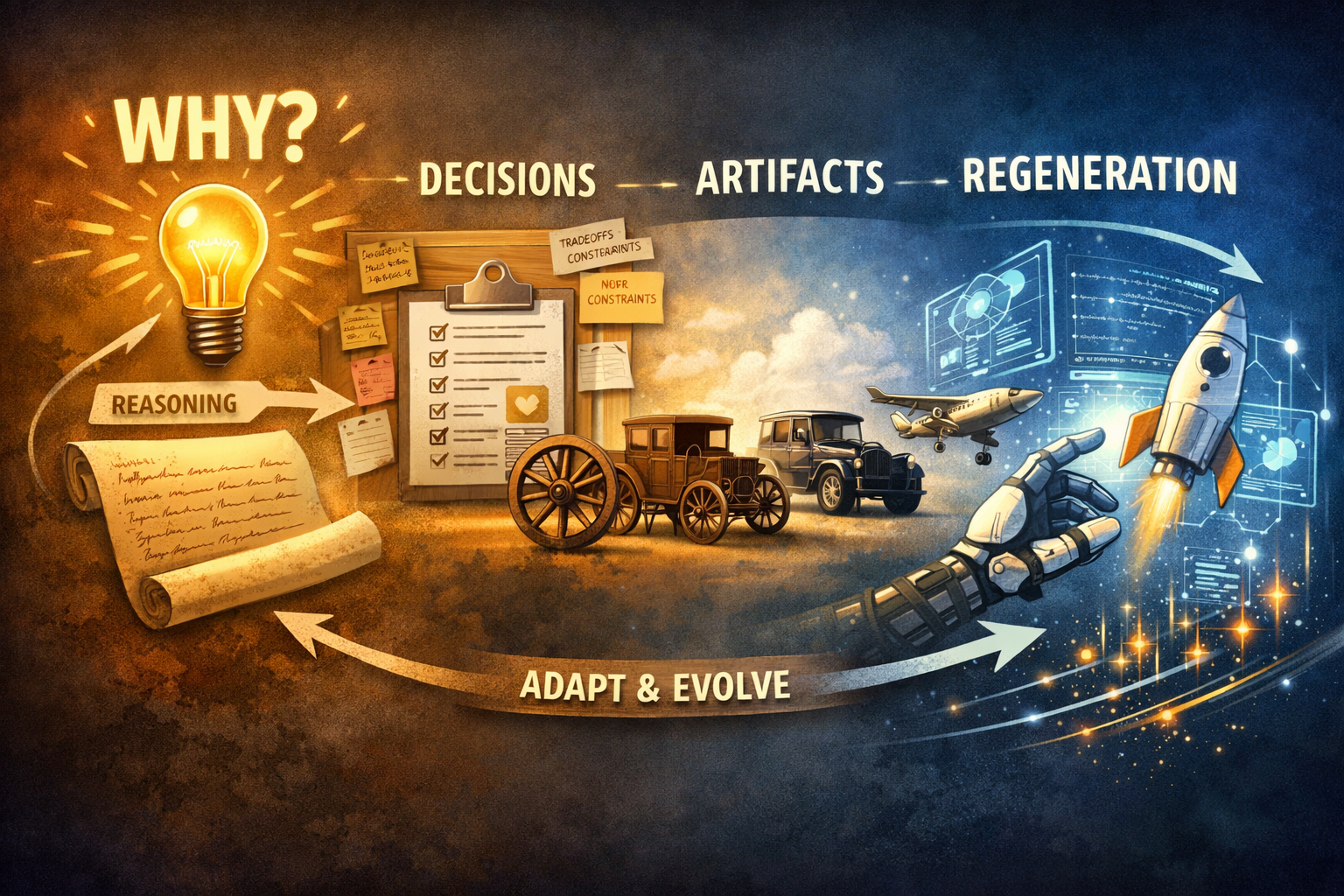
Across centuries, humanity has created an entire sequence of transportation technologies:
- the wheel
- the carriage
- the automobile
- the airplane
- the rocket
At first glance these appear to be separate inventions belonging to completely different technological eras. Yet if we look more closely, they all represent variations of the same underlying decision.
Humans wanted to move from one place to another faster and more efficiently.
The decision remained constant, while the implementations evolved as technology advanced. The carriage did not disappear because the idea behind it was wrong; it disappeared because better ways of implementing the same intention became possible. If historians had preserved only the physical design of the carriage and lost the reasoning behind it, that artifact would eventually become nothing more than a museum piece.
The reasoning, however, continues to generate new solutions.
This distinction becomes even more important in the age of artificial intelligence. AI systems dramatically reduce the cost of producing artifacts. Code can be generated in minutes. Architectures can be proposed automatically. Infrastructure configurations can be assembled with increasing levels of automation. As the cost of producing the what continues to fall, the relative value of the why increases.
Yet most organizations still treat reasoning as something temporary, something that exists only during the moment of discussion.
If AI accelerates the production of systems, organizations will need a new capability to preserve the reasoning behind them. Instead of storing only the final artifacts, we will need systems that record decisions themselves as structured entities. These systems would capture the assumptions, constraints, trade-offs, risks, and alternative paths that shaped the outcome.
In other words, software development will need a memory layer for decisions.
Once decisions become first-class artifacts, something fundamentally changes. When the environment evolves, we are no longer forced to rediscover the reasoning behind the system through archaeology and speculation. Instead, we can revisit the original decision, update the assumptions that are no longer valid, and regenerate the implementation in a way that reflects the new context.
This approach transforms systems from static structures into something closer to living designs. The artifact may change repeatedly as technology evolves, but the reasoning that drives those changes remains visible and traceable.
In the AI-augmented world, the most resilient organizations will not necessarily be the ones with the most polished architectures today. They will be the ones that preserve the intellectual lineage behind those architectures, allowing them to evolve continuously as the environment changes.
Architectures may age, frameworks may disappear, and infrastructure may be replaced, but decisions can evolve as long as their reasoning remains visible.
And once the why is preserved, the what can always be rebuilt.