2030 A Provenance-Native Company.
Author: Yauheni Kurbayeu
Published: March 13, 2026
LinkedIn
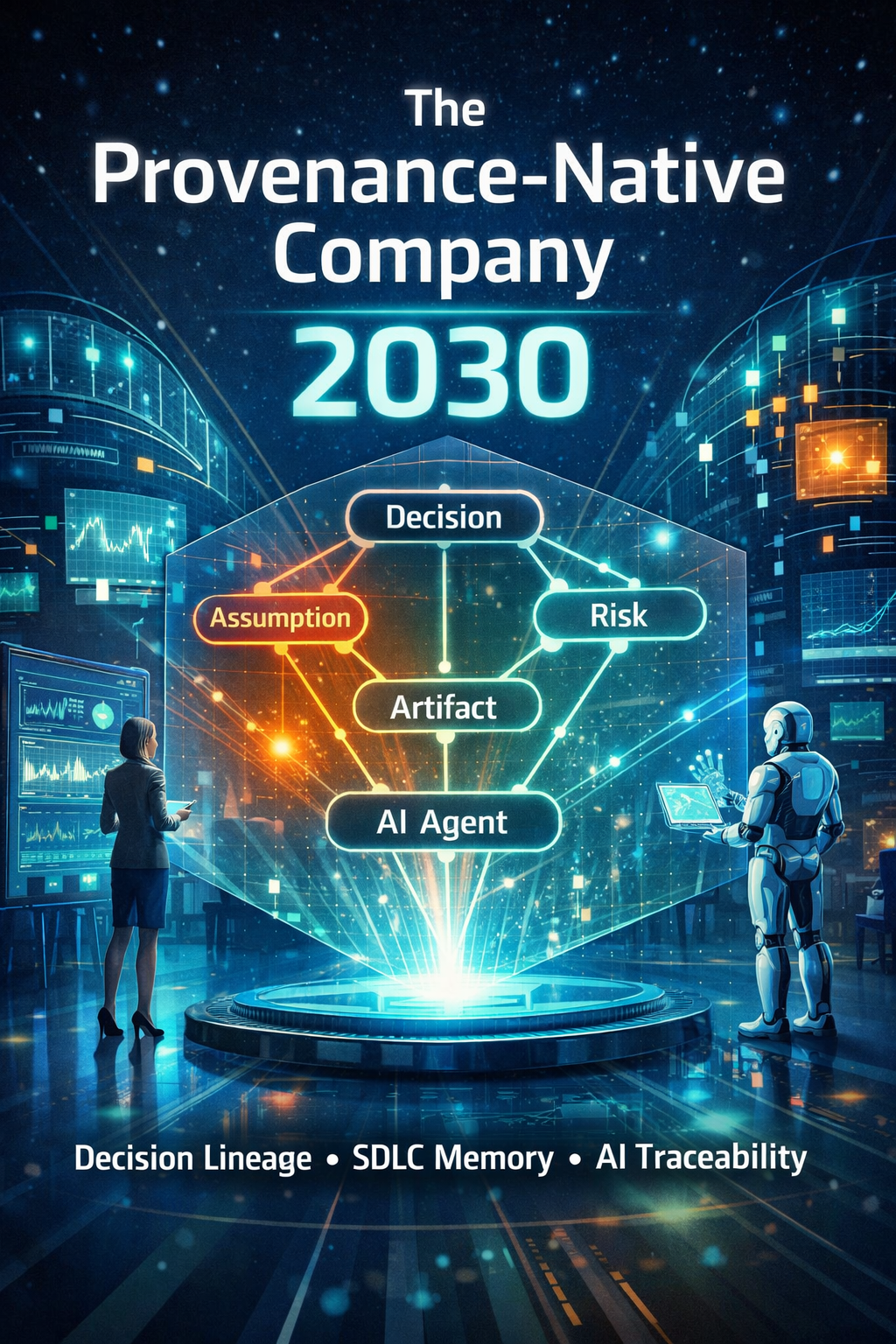
Let's imagine a "Provenance-native company" in 2030 - an organization built from the beginning around decision lineage, SDLC memory, and AI execution traceability rather than trying to retrofit it later.
1. Organizational Memory Is Core Infrastructure.
In a provenance-native company, organizational memory is treated as infrastructure, not documentation.
Instead of knowledge being scattered across tools like Jira, Slack, GitHub, and Notion, all work events automatically produce structured provenance records.
Every meaningful action generates nodes in a decision graph:
-   Decision
-   Assumption
-   Constraint
-   Risk
-   Experiment
-   Artifact
-   Agent execution
These nodes are automatically linked.
The result is a living causal graph of the organization.
Not documentation written afterward, but memory produced as a side-effect of work.
2. AI Agents Are Required to Produce Provenance.
In 2030 most work involves AI agents.
In a provenance-native company, AI agents cannot execute without producing traceability records.
Every execution captures:
-   Agent identity
-   Model version
-   Inputs
-   Reasoning chain
-   Tools used
-   Decision references
-   Output artifacts
-   Confidence / risk notes
This becomes standard operational telemetry, similar to observability today.
But instead of observing systems, the company observes decision flows.
3. Architecture Becomes a Living Decision Graph.
Architecture diagrams become secondary.
Instead, architecture is represented as a graph of decisions over time.
Example:
Decision: Split EU infrastructure
  ├── Assumption: GDPR enforcement risk
  ├── Constraint: Data residency
  ├── Risk: Deployment complexity
  └── Resulting artifacts:
          - AWS EU cluster
          - Separate pipelines
Six months later another node appears:
Decision: Merge EU & US services
Reason: Regulatory change
Supersedes: Decision #231
Architecture becomes time-aware reasoning, not static diagrams.
4. Meetings Become Decision Capture Systems.
Meetings still exist, but their purpose changes.
Instead of discussions disappearing into notes, systems extract:
-   Proposed decisions
-   Risks
-   Assumptions
-   Disagreements
-   Action items
These are stored as structured nodes.
The system automatically links them to:
- code changes
- product features
- incidents
- experiments
Over time the company accumulates a causal history of why things happened.
5. Incidents Are Investigated Through Decision Lineage.
Today incident analysis usually focuses on:
- logs
- metrics
- code
In a provenance-native company the investigation starts differently:
Which decision chain produced the failure?
Example:
Incident: Payment outage

Trace:
    Code change
    ↓
    Decision: switch payment provider
    ↓
    Assumption: fallback system ready
    ↓
    Assumption invalid
Root cause becomes invalid assumptions, not just broken code.
6. Institutional Knowledge Becomes Queryable.
Employees can ask:
- Why do we use this architecture?
- What assumptions justify this constraint?
- Which decisions depend on this component?
The system reconstructs answers using the decision graph.
This is fundamentally different from RAG over documentation.
It answers using causal lineage, not text similarity.
7. Strategy Is Tracked as Decision Evolution.
Even executive decisions are recorded in the provenance graph.
Example:
Strategic Decision: Enter EU market
Assumptions:
    - EU demand growing
    - compliance manageable

Constraints:
    - data residency
    - local legal frameworks
Two years later:
Decision: Expand EU infrastructure
Supersedes: initial EU strategy
Reason: adoption exceeded forecast
Strategy becomes traceable reasoning over time.
8. The Company Develops "Decision Capital".
This is the most interesting outcome.
Today companies accumulate:
- code
- data
- documents
A provenance-native company accumulates decision capital.
Meaning it has a historical graph of:
- trade-offs
- failed ideas
- validated assumptions
- architecture evolution
- strategic reasoning
New employees and AI systems can instantly understand the organization's reasoning.
This dramatically accelerates onboarding and strategic alignment.
9. AI Becomes Safer to Use.
One of the biggest problems with AI systems today is accountability.
In a provenance-native company every AI action can be traced to:
- who approved the objective
- which assumptions were used
- which model produced the result
- which decision chain authorized the execution
This makes AI auditable and governable.
10. Culture Shifts Toward Decision Thinking
Engineers stop asking:
"What code should we write?"
They start asking:
"What decision are we making?"
Artifacts like code, documents, and experiments become consequences of decisions.
The Irony
The most interesting aspect of this future is that it does not require revolutionary technology.
Everything needed already exists:
- graph databases
- vector embeddings
- AI agents
- event pipelines
- observability stacks
What's missing is the mental model.
That is exactly what the Provenance Manifesto introduces.