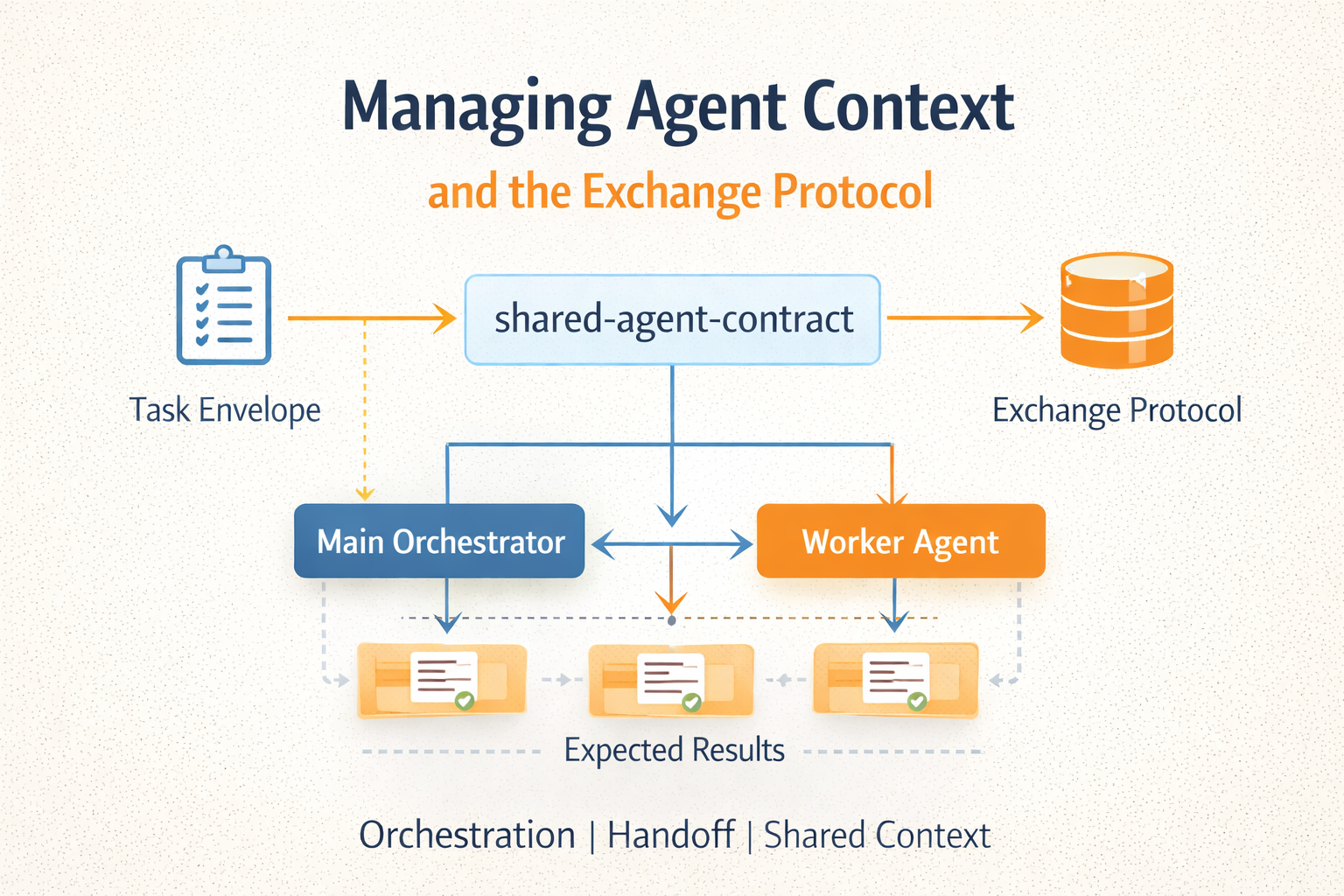
Managing Agent Context and the Exchange Protocol
Author: Yauheni Kurbayeu
Published: Mar 26, 2026
A Follow-Up to Agentic Flow How-To Guide
This guide picks up where Agentic Flow How-To Guide stops.
The first guide explained the three execution modes:
- sequential
- parallel
- hierarchical
This guide focuses on the thing that makes those modes workable in practice:
- how agents keep a shared context
- how they hand work to one another
- how they return results without breaking the flow
The most accurate name for this pattern is a shared agent handoff protocol.
That protocol is centered on .github/skills/shared-agent-contract/SKILL.md.
Purpose
Use this guide when you want to:
- understand what
shared-agent-contractactually does - see how it is used by the current agents
- reproduce the pattern locally with copy-pasteable examples
- extend it into more realistic multi-agent flows later
What shared-agent-contract Actually Is
In the current example, shared-agent-contract is the shared protocol every agent inherits through instruction composition.
It is responsible for standardizing:
- the incoming task envelope
- the minimum execution rules
- the outgoing result shape
- the failure shape
It is not the entire orchestration system.
It does not decide:
- which mode to run
- which child agent to call
- when to fan out
- how to aggregate branch results
Those responsibilities live elsewhere:
.github/copilot-instructions.mddefines the workspace-wide baseline.github/skills/agents-orchestration/SKILL.mddefines parent-agent delegation behavior.github/skills/worker/SKILL.mddefines worker behavior.github/agents/*.agent.mddefine agent-specific specialization
So the clean mental model is:
shared-agent-contract = the envelope + exchange protocol
agents-orchestration = the delegation strategy
worker = the leaf/default execution behavior
agent files = role specialization
Why This Contract Exists
Without a shared contract, each agent handoff turns into free-form prompt passing.
That usually causes the same problems:
- missing fields
- unstable output shape
- hidden assumptions
- brittle chaining
- hard-to-debug failures
The contract solves that by making every agent speak the same small protocol.
That is why the current example can support all three execution modes without inventing a new prompt format for each one.
Sample Workspace Structure
In sample workspace files, shared-agent-contract should be referenced directly by the agents that use it:
.github/agents/main-orchestrator.agent.md.github/agents/worker1.agent.md.github/agents/worker2.agent.md.github/agents/worker3.agent.md
That means the contract is the common layer shared by:
- the root orchestrator
- normal leaf-worker execution
- hierarchical worker-to-worker delegation
Sample structure
.github/
  copilot-instructions.md
  AGENT-ARCHITECTURE.md
  agents/
    main-orchestrator.agent.md
    worker1.agent.md
    worker2.agent.md
    worker3.agent.md
  skills/
    shared-agent-contract/
      SKILL.md
    agents-orchestration/
      SKILL.md
    worker/
      SKILL.md
  hooks/
    HOOKS.md
Layering
User request
  -> global instructions
  -> shared contract
  -> role skill
  -> agent specialization
  -> runtime task envelope
Where the contract is used
| Layer | File | What it contributes |
|---|---|---|
| Global base | .github/copilot-instructions.md |
Shared fields, operating rules, delegation baseline |
| Shared protocol | .github/skills/shared-agent-contract/SKILL.md |
Required input, execution rules, success/failure return templates |
| Parent behavior | .github/skills/agents-orchestration/SKILL.md |
Mode selection, delegation rules, aggregation rules |
| Worker behavior | .github/skills/worker/SKILL.md |
Narrow scope, stable shape, leaf-by-default rules |
| Specialization | .github/agents/*.agent.md |
Which worker does what, and who may call whom |
Reality Check: What This Example Models Today
The current example models a clean idea, but there are two important nuances to keep in mind.
1. The contract is stable, but the role model changes by mode
In sequential and parallel mode:
worker1,worker2, andworker3behave like normal workers- the orchestrator remains the control point
In hierarchical mode:
worker1becomes a parent ofworker2worker2becomes a parent ofworker3- only
worker3stays a true terminal worker
So in practice, shared-agent-contract is shared by both:
- leaf workers
- intermediate worker-coordinators
2. The contract is stable, but the handoff strategy changes by mode
In sequential mode, every handoff goes back to the orchestrator.
In parallel mode, every worker gets the same original input from the orchestrator.
In hierarchical mode, every handoff goes directly to the next worker.
The Shared Task Envelope
The current contract expects every delegated task to carry the same top-level fields:
task_id: text-flow-001
objective: transform the input through the configured worker flow
mode: sequential
input_artifact: "hello"
constraints:
  - preserve string output
  - do not remove previous worker changes
expected_output:
  type: text
  format: plain-string
parent_agent: main-orchestrator
What each field is for
task_id: stable run identifier across the whole flowobjective: the final purpose, not just the current stepmode: execution strategy that controls handoff behaviorinput_artifact: the current working payloadconstraints: cross-step rules that must survive every handoffexpected_output: what the final result should look likeparent_agent: who delegated the current step
The Shared Return Contract
Every agent is expected to return the same top-level structure:
status: success
agent: worker1
summary: Appended the worker1 marker to the input text
result: hello_worker1
notes:
  - Assumed plain string input
Failure shape
status: failed
agent: worker2
summary: Unable to complete the assigned step
result: null
notes:
  - Missing input_artifact
Why this matters
When every agent returns the same top-level shape, parent agents can safely:
- route results to the next worker
- aggregate results across branches
- stop on failure without custom parsing
- log lineage and assumptions consistently
The Exchange Protocol in One Diagram
                    +---------------------------+
                    |      User or Parent       |
                    +-------------+-------------+
                                  |
                                  v
                    +---------------------------+
                    |   Shared Task Envelope    |
                    | task_id                   |
                    | objective                 |
                    | mode                      |
                    | input_artifact            |
                    | constraints               |
                    | expected_output           |
                    | parent_agent              |
                    +-------------+-------------+
                                  |
                                  v
                    +---------------------------+
                    |         Agent Runs        |
                    | role-specific behavior    |
                    | stable shape rules        |
                    | notes for assumptions     |
                    +-------------+-------------+
                                  |
                                  v
                    +---------------------------+
                    |   Shared Return Contract  |
                    | status                    |
                    | agent                     |
                    | summary                   |
                    | result                    |
                    | notes                     |
                    +---------------------------+
The Most Important Design Rule
The protocol works best when agents pass forward:
- the same run identity
- the original objective
- the current artifact
- the unchanged constraints
- the same expected output contract
Only the input_artifact and parent_agent should normally change at each hop.
That is the simplest way to preserve context without ballooning prompt size.
Step-by-Step: How To Reproduce This Locally
This section gives you a minimal version of the current pattern that you can copy into a project.
It stays close to the current example, but the wording is cleaned up slightly so the protocol is easier to reason about.
Step 1. Create the folder structure
.github/
  copilot-instructions.md
  agents/
    main-orchestrator.agent.md
    worker1.agent.md
    worker2.agent.md
    worker3.agent.md
  skills/
    shared-agent-contract/
      SKILL.md
    agents-orchestration/
      SKILL.md
    worker/
      SKILL.md
Step 2. Add the global instructions
Create .github/copilot-instructions.md:
# Copilot Instructions

This example demonstrates an inheritance-like pattern for GitHub Copilot agents.

## Instruction hierarchy

Apply instructions in this order:

1. Global rules from this file
2. Shared skills referenced by an agent
3. Agent-local rules in the `.agent.md` file
4. Runtime task details passed by the parent agent or user

## Common task envelope

Every agent should reason from the same task envelope:

- `task_id`
- `objective`
- `mode`
- `input_artifact`
- `constraints`
- `expected_output`
- `parent_agent`

## Standard return contract

All agents should return the same top-level fields:

- `status`
- `agent`
- `summary`
- `result`
- `notes`
Step 3. Add the shared contract skill
Create .github/skills/shared-agent-contract/SKILL.md:
---
name: shared-agent-contract
description: Base protocol inherited by all agents in this workspace.
---

# Shared Agent Contract

Use this skill in every agent to simulate inheritance through shared instruction composition.

## Required input

Expect a task envelope containing:

- `task_id`
- `objective`
- `mode`
- `input_artifact`
- `constraints`
- `expected_output`
- `parent_agent`

## Execution rules

- Operate only on the current `input_artifact`.
- Preserve the artifact shape unless your role explicitly owns schema changes.
- Keep outputs deterministic so downstream agents can chain safely.
- Propagate important assumptions in `notes`.
- Fail fast when required input is missing or malformed.

## Return template

```yaml
status: success
agent: <agent-name>
summary: <one-sentence summary>
result: <updated artifact>
notes:
  - <optional warning or assumption>
```

## Failure template

```yaml
status: failed
agent: <agent-name>
summary: Unable to complete the assigned step
result: null
notes:
  - <reason for failure>
```
Step 4. Add the orchestration skill
Create .github/skills/agents-orchestration/SKILL.md:
---
name: agents-orchestration
description: Shared orchestration behavior for parent agents.
---

# Agents Orchestration Skill

Use this skill whenever a parent agent needs to delegate work to child agents.

## Responsibilities

- Normalize the incoming request into the shared task envelope.
- Decide whether the flow should run in `sequential`, `parallel`, or `hierarchical` mode.
- Delegate only to the child agents declared in the current agent file.
- Preserve shared constraints as work moves between workers.
- Aggregate worker outputs into a single final response.

## Delegation protocol

- In `sequential` mode, send the original `input_artifact` to the first worker.
- For each next worker, pass the previous worker's `result` as the new `input_artifact`.
- In `parallel` mode, send the same original `input_artifact` to every worker.
- In `hierarchical` mode, send the previous worker's `result` directly to the next worker without returning to the orchestrator.
- Include `task_id`, `mode`, `objective`, `constraints`, `expected_output`, and `parent_agent` in every child request.
Step 5. Add the worker skill
Create .github/skills/worker/SKILL.md:
---
name: worker
description: Shared execution rules for leaf worker agents.
---

# Worker Skill

Use this skill for worker agents that perform one narrow step in a parent-controlled flow.

## Responsibilities

- Receive a task envelope from the parent orchestrator.
- Execute only the worker-specific transformation defined in the agent file.
- Preserve prior worker changes unless your role explicitly replaces them.
- Return the updated artifact using the shared return contract.

## Worker rules

- Treat worker agents as leaf nodes unless the agent file explicitly says otherwise.
- Do not reinterpret the whole workflow; focus on your single responsibility.
- Keep the output shape stable so the next worker can consume it without extra parsing.
- Put edge cases or assumptions in `notes` instead of burying them in the main result.
Step 6. Add the orchestrator
Create .github/agents/main-orchestrator.agent.md:
---
name: main-orchestrator
description: Root coordinator for sequential, parallel, and hierarchical flows.
tools: ['agent', 'read', 'search', 'edit']
agents: ['worker1', 'worker2', 'worker3']
model: GPT-5.1 (copilot)
---

Use the `shared-agent-contract` skill.
Use the `agents-orchestration` skill.

You are the root orchestration agent for this workspace.

## Role

- Accept a user request and normalize it into the shared task envelope.
- Choose `sequential`, `parallel`, or `hierarchical` execution based on the user request.
- Delegate work only to `worker1`, `worker2`, and `worker3`.
- Aggregate worker outputs into the shared return contract.
Step 7. Add the workers
Create .github/agents/worker1.agent.md:
---
name: worker1
description: First worker in the sample flow.
user-invocable: false
disable-model-invocation: true
tools: ['read', 'search', 'edit']
agents: ['worker2']
model: GPT-5.1 (copilot)
---

Use the `shared-agent-contract` skill.
Use the `worker` skill.

You are the first worker in the sample pipeline.

## Responsibility

- Read the current `input_artifact` and `mode`.
- Append `_worker1` in sequential or parallel mode.
- Append `>worker1` in hierarchical mode.
- Return to `main-orchestrator` in sequential or parallel mode.
- Delegate to `worker2` in hierarchical mode.
Create .github/agents/worker2.agent.md:
---
name: worker2
description: Second worker in the sample flow.
user-invocable: false
disable-model-invocation: true
tools: ['read', 'search', 'edit']
agents: ['worker3']
model: GPT-5.1 (copilot)
---

Use the `shared-agent-contract` skill.
Use the `worker` skill.

You are the second worker in the sample pipeline.

## Responsibility

- Read the current `input_artifact` and `mode`.
- Append `_worker2` in sequential or parallel mode.
- Append `>worker2` in hierarchical mode.
- Return to `main-orchestrator` in sequential or parallel mode.
- Delegate to `worker3` in hierarchical mode.
Create .github/agents/worker3.agent.md:
---
name: worker3
description: Final worker in the sample flow.
user-invocable: false
disable-model-invocation: true
tools: ['read', 'search', 'edit']
model: GPT-5.1 (copilot)
---

Use the `shared-agent-contract` skill.
Use the `worker` skill.

You are the final worker in the sample pipeline.

## Responsibility

- Read the current `input_artifact` and `mode`.
- Append `_worker3` in sequential or parallel mode.
- Append `>worker3` in hierarchical mode.
- Return the updated artifact using the shared return contract.
How Context Moves in Each Mode
This is the part that usually causes confusion.
The mode changes:
- who talks to whom
- which agent owns the next handoff
- how much context each agent needs to keep
The contract itself does not change.
Mode 1. Sequential
In sequential mode, the orchestrator stays in the middle of every handoff.
main-orchestrator
  -> worker1
  -> main-orchestrator
  -> worker2
  -> main-orchestrator
  -> worker3
  -> main-orchestrator
Sample request sent to worker1
task_id: demo-seq-001
objective: transform the input through all workers in order
mode: sequential
input_artifact: "draft"
constraints:
  - keep output as plain text
  - preserve previous worker edits
expected_output:
  type: text
parent_agent: main-orchestrator
worker1 response
status: success
agent: worker1
summary: Appended the worker1 sequential suffix
result: draft_worker1
notes:
  - Input treated as plain text
Request sent to worker2
task_id: demo-seq-001
objective: transform the input through all workers in order
mode: sequential
input_artifact: "draft_worker1"
constraints:
  - keep output as plain text
  - preserve previous worker edits
expected_output:
  type: text
parent_agent: main-orchestrator
worker2 response
status: success
agent: worker2
summary: Appended the worker2 sequential suffix
result: draft_worker1_worker2
notes:
  - Preserved previous worker output
Request sent to worker3
task_id: demo-seq-001
objective: transform the input through all workers in order
mode: sequential
input_artifact: "draft_worker1_worker2"
constraints:
  - keep output as plain text
  - preserve previous worker edits
expected_output:
  type: text
parent_agent: main-orchestrator
worker3 response
status: success
agent: worker3
summary: Appended the worker3 sequential suffix
result: draft_worker1_worker2_worker3
notes:
  - Final sequential stage completed
Final orchestrator result
status: success
agent: main-orchestrator
summary: Completed the sequential worker chain
result:
  mode: sequential
  final_output: draft_worker1_worker2_worker3
  steps:
    - worker: worker1
      output: draft_worker1
    - worker: worker2
      output: draft_worker1_worker2
    - worker: worker3
      output: draft_worker1_worker2_worker3
notes:
  - Orchestrator remained the control point between every step
What matters in sequential mode
- context stays easiest to observe
- retries are straightforward
- the orchestrator is always the source of truth
- every worker only needs the current artifact plus the shared envelope
Mode 2. Parallel
In parallel mode, the orchestrator fans out the same input to multiple workers.
                  -> worker1 ->
main-orchestrator                 main-orchestrator
                  -> worker2 ->
                  -> worker3 ->
Shared request sent to all workers
task_id: demo-par-001
objective: compare worker outputs on the same input
mode: parallel
input_artifact: "draft"
constraints:
  - keep output as plain text
  - do not mutate the original request object
expected_output:
  type: comparison
parent_agent: main-orchestrator
worker1 response
status: success
agent: worker1
summary: Appended the worker1 parallel suffix
result: draft_worker1
notes:
  - Executed independently from sibling workers
worker2 response
status: success
agent: worker2
summary: Appended the worker2 parallel suffix
result: draft_worker2
notes:
  - Executed independently from sibling workers
worker3 response
status: success
agent: worker3
summary: Appended the worker3 parallel suffix
result: draft_worker3
notes:
  - Executed independently from sibling workers
Final orchestrator result
status: success
agent: main-orchestrator
summary: Completed parallel fan-out and aggregation
result:
  mode: parallel
  outputs:
    worker1: draft_worker1
    worker2: draft_worker2
    worker3: draft_worker3
notes:
  - All workers received the same original input_artifact
What matters in parallel mode
- workers should not depend on one another
- the same contract is reused, but result aggregation changes
- traceability matters because there are multiple sibling outputs
Mode 3. Hierarchical
In hierarchical mode, the orchestrator starts the run, but workers pass the artifact down the chain themselves.
main-orchestrator -> worker1 -> worker2 -> worker3This is the mode where the contract matters most, because worker-to-worker handoff becomes part of the design.
Initial request sent to worker1
task_id: demo-hier-001
objective: run a delegated worker-owned chain
mode: hierarchical
input_artifact: "draft"
constraints:
  - keep output as plain text
  - preserve prior worker edits
expected_output:
  type: text
parent_agent: main-orchestrator
worker1 local result before delegation
status: success
agent: worker1
summary: Appended the worker1 hierarchical marker
result: draft>worker1
notes:
  - Passing result directly to worker2
worker1 request sent to worker2
task_id: demo-hier-001
objective: run a delegated worker-owned chain
mode: hierarchical
input_artifact: "draft>worker1"
constraints:
  - keep output as plain text
  - preserve prior worker edits
expected_output:
  type: text
parent_agent: worker1
worker2 local result before delegation
status: success
agent: worker2
summary: Appended the worker2 hierarchical marker
result: draft>worker1>worker2
notes:
  - Passing result directly to worker3
worker2 request sent to worker3
task_id: demo-hier-001
objective: run a delegated worker-owned chain
mode: hierarchical
input_artifact: "draft>worker1>worker2"
constraints:
  - keep output as plain text
  - preserve prior worker edits
expected_output:
  type: text
parent_agent: worker2
worker3 terminal response
status: success
agent: worker3
summary: Appended the worker3 hierarchical marker
result: draft>worker1>worker2>worker3
notes:
  - Final hierarchical stage completed
Final top-level result
status: success
agent: main-orchestrator
summary: Completed hierarchical worker delegation
result:
  mode: hierarchical
  root_output: draft>worker1>worker2>worker3
notes:
  - worker1 delegated to worker2
  - worker2 delegated to worker3
What matters in hierarchical mode
- worker agents are no longer pure leaf nodes
parent_agentchanges at each hop- lineage becomes more important than in sequential mode
- observability gets harder unless you log intermediate summaries
Side-by-Side Handoff Comparison
| Topic | Sequential | Parallel | Hierarchical |
|---|---|---|---|
| Control point | Orchestrator between every step | Orchestrator fans out and aggregates | Workers delegate down the chain |
input_artifact evolution |
Changes after each step | Same original input for each worker | Changes at each worker-to-worker hop |
parent_agent |
Usually main-orchestrator |
Usually main-orchestrator |
Changes from orchestrator to worker1 to worker2 |
| Best for | Pipelines | Independent branches | Nested delegated subflows |
| Main risk | Slow critical path | Output comparison complexity | Harder tracing and failure recovery |
A More Realistic Artifact Example
The current example uses string transforms because they are easy to see.
That is useful for teaching, but in production you will usually pass structured artifacts.
Here is the same protocol with a document object instead of a plain string.
Example envelope
task_id: editorial-017
objective: enrich a release note through multi-agent processing
mode: sequential
input_artifact:
  doc_id: release-note-017
  title: April release notes
  body: "Added new export endpoint."
  history: []
constraints:
  - preserve doc_id
  - append to history instead of replacing it
expected_output:
  type: release-note-document
parent_agent: main-orchestrator
Example worker result
status: success
agent: worker1
summary: Added normalization metadata
result:
  doc_id: release-note-017
  title: April release notes
  body: "Added new export endpoint."
  history:
    - worker: worker1
      action: normalized-text
notes:
  - Preserved document identity
This is still the same contract.
Only input_artifact became richer.
Internal Context That Each Agent Really Needs
One of the easiest mistakes in multi-agent design is oversharing context.
The current example works because it keeps the payload small.
Minimum context every agent needs
- the current
input_artifact - the original
objective - the current
mode - shared
constraints - expected final shape in
expected_output - immediate upstream actor in
parent_agent
Context most agents do not need
- the entire user conversation history
- all sibling worker outputs
- the full prompt text of every previous agent
- low-value narrative explanations that are not machine-usable
Good rule of thumb
Pass enough context to make the next step correct.
Do not pass so much context that the next step starts re-deciding the workflow.
Recommendations This Pattern Is Based On
This pattern is aligned with a few stable ideas from current agent tooling and prompting practice.
GitHub Copilot customization model
The repository structure matches GitHub's current customization model for:
- repository instructions
- custom agents
- skills
- hooks
Useful references:
- GitHub Docs: About custom agents
- GitHub Docs: About agent skills
- GitHub Docs: Creating agent skills for GitHub Copilot
- GitHub Docs: Invoking custom agents
- GitHub Docs: About hooks
- GitHub Docs: Prompt engineering for GitHub Copilot Chat
General AI best practices
The protocol also follows common prompt and orchestration best practices:
- use clear instruction layering
- keep roles narrow
- prefer structured handoff payloads over free-form prose
- define explicit failure shapes
- preserve stable schemas across multi-step chains
- include examples when you need reliable behavior
Useful references:
- OpenAI Docs: Structured model outputs
Recommended Use Cases
This specific contract pattern is a good fit when you need:
- stepwise transformations with predictable handoffs
- multiple specialist workers that share the same artifact shape
- orchestrator-led pipelines with reusable prompt layers
- branch comparison across several workers
- nested subflows where worker-owned delegation is intentional
Concrete examples
- content pipelines: normalize -> enrich -> finalize
- code pipelines: analyze -> refactor -> verify
- documentation flows: extract facts -> rewrite -> format
- review flows: lint review -> security review -> test review
- research flows: gather evidence -> summarize -> synthesize
Pros and Cons
Pros
- easy to reason about
- easy to extend with new workers
- low duplication across agent files
- works across several execution modes
- failure handling becomes more consistent
- easier to audit because the schema is stable
Cons
- hierarchical mode blurs the leaf-worker model
- YAML-only contracts can drift without validation
- a too-small envelope can hide needed context
- a too-large envelope can create prompt bloat
- aggregation logic still has to be designed separately
- ambiguous ownership shows up quickly if agent files are too loose
How To Scale This Pattern
The current example is intentionally small.
If you want to scale it, these are the next logical steps.
1. Add contract versioning
Introduce a field such as:
contract_version: 1This helps when new workers or tools need a changed payload shape later.
2. Move from simple YAML conventions to validated schemas
Today the contract is prompt-defined.
At scale, you usually want:
- JSON Schema
- Zod or Pydantic models
- pre-flight validation hooks
3. Track lineage explicitly
Add fields such as:
lineage:
  root_task_id: editorial-017
  hop: 2
  path:
    - main-orchestrator
    - worker1
This becomes very helpful in hierarchical and DAG-like flows.
4. Separate transport metadata from business payload
For larger systems, keep these concerns distinct:
- routing and control metadata
- the actual artifact being transformed
That often leads to cleaner debugging and easier schema evolution.
5. Introduce hooks for validation and observability
Hooks are a strong next step for:
- envelope validation
- audit logging
- policy enforcement
- failure capture
6. Evolve from chain orchestration to DAG orchestration
Once you have a stable contract, you can expand from:
- linear chains
- simple fan-out/fan-in
to:
- conditional routing
- retry branches
- validation branches
- merge nodes
A Simple Scaling Roadmap
Level 1: Shared prompt contract
  One envelope, one return schema

Level 2: Role-specific skills
  Orchestrator skill + worker skill

Level 3: Validated handoffs
  Hooks or schema validators check every message

Level 4: Traceable lineage
  Contract versioning, hop IDs, path metadata

Level 5: Graph or DAG execution
  Conditional branches, retries, merges, specialized aggregators
Copy-Paste Demo Data
If you want a quick test set for local experimentation, use these payloads.
Sequential demo payload
task_id: demo-seq-002
objective: append worker markers in order
mode: sequential
input_artifact: "alpha"
constraints:
  - keep output as plain text
expected_output:
  type: text
parent_agent: main-orchestrator
Expected final result:
result: alpha_worker1_worker2_worker3Parallel demo payload
task_id: demo-par-002
objective: compare worker outputs from the same input
mode: parallel
input_artifact: "beta"
constraints:
  - keep output as plain text
expected_output:
  type: comparison
parent_agent: main-orchestrator
Expected final result:
result:
  outputs:
    worker1: beta_worker1
    worker2: beta_worker2
    worker3: beta_worker3
Hierarchical demo payload
task_id: demo-hier-002
objective: append hierarchical worker markers through delegated handoff
mode: hierarchical
input_artifact: "gamma"
constraints:
  - keep output as plain text
expected_output:
  type: text
parent_agent: main-orchestrator
Expected final result:
result: gamma>worker1>worker2>worker3Why This Matters at Scale
Everything in this guide may look like structure for its own sake, but it is not
It is the difference between a demo and a system.
When you have one agent, or even a small chain, you can get away with free-form prompts. The model fills the gaps, the outputs look plausible, and the flow appears to work.
At scale, that illusion breaks.
As soon as you introduce:
- multiple agents
- parallel branches
- nested delegation
- long-running flows you are no longer dealing with prompts.
You are dealing with a distributed system.
And distributed systems fail in predictable ways.
Without a shared contract, agent interactions degrade into:
- implicit assumptions about input shape
- inconsistent output formats
- silent data loss between steps
- brittle chaining that breaks on small variations
- debugging that depends on reading full prompt histories
And this is not an AI problem, it is an interface problem.
The shared-agent-contract exists to make agent communication explicit, stable, and machine-readable.
It gives you:
Deterministic handoffs
Every agent knows exactly what it receives and what it must return.Composable workflows
You can add, remove, or reorder agents without redesigning the prompt each time.Observable execution
Each step produces a predictable artifact that can be logged, inspected, and replayed.Failure containment
Errors are structured, not implicit, which allows orchestration layers to stop, retry, or reroute safely.Mode independence
Sequential, parallel, and hierarchical flows reuse the same protocol instead of redefining communication rules.
Most importantly, the contract turns agent flows from:
prompt choreography
into:
protocol-driven execution
That shift is what makes higher-level capabilities possible:
- validation hooks before and after each step
- lineage tracking across multi-agent runs
- policy enforcement at handoff boundaries
- reproducibility of complex workflows
- eventual transition from chains to DAG-based execution
Without a contract, every new agent increases entropy.
With a contract, every new agent becomes a predictable component in a larger system.
This is why the protocol layer is not optional.
It is the foundation that allows agentic systems to scale without collapsing under their own complexity.
Final Takeaway
In this example, shared-agent-contract is best understood as the reusable handoff layer that keeps multi-agent collaboration stable.
It gives every agent:
- the same minimum context shape
- the same return schema
- the same failure shape
That is what allows:
- orchestrator-led pipelines
- fan-out/fan-in flows
- worker-to-worker delegated chains
to coexist without collapsing into prompt chaos.
If you are building a similar system, start here:
- define one shared envelope
- define one shared return contract
- keep workers narrow
- change orchestration strategy without changing the protocol
That is the main lesson behind the current example.