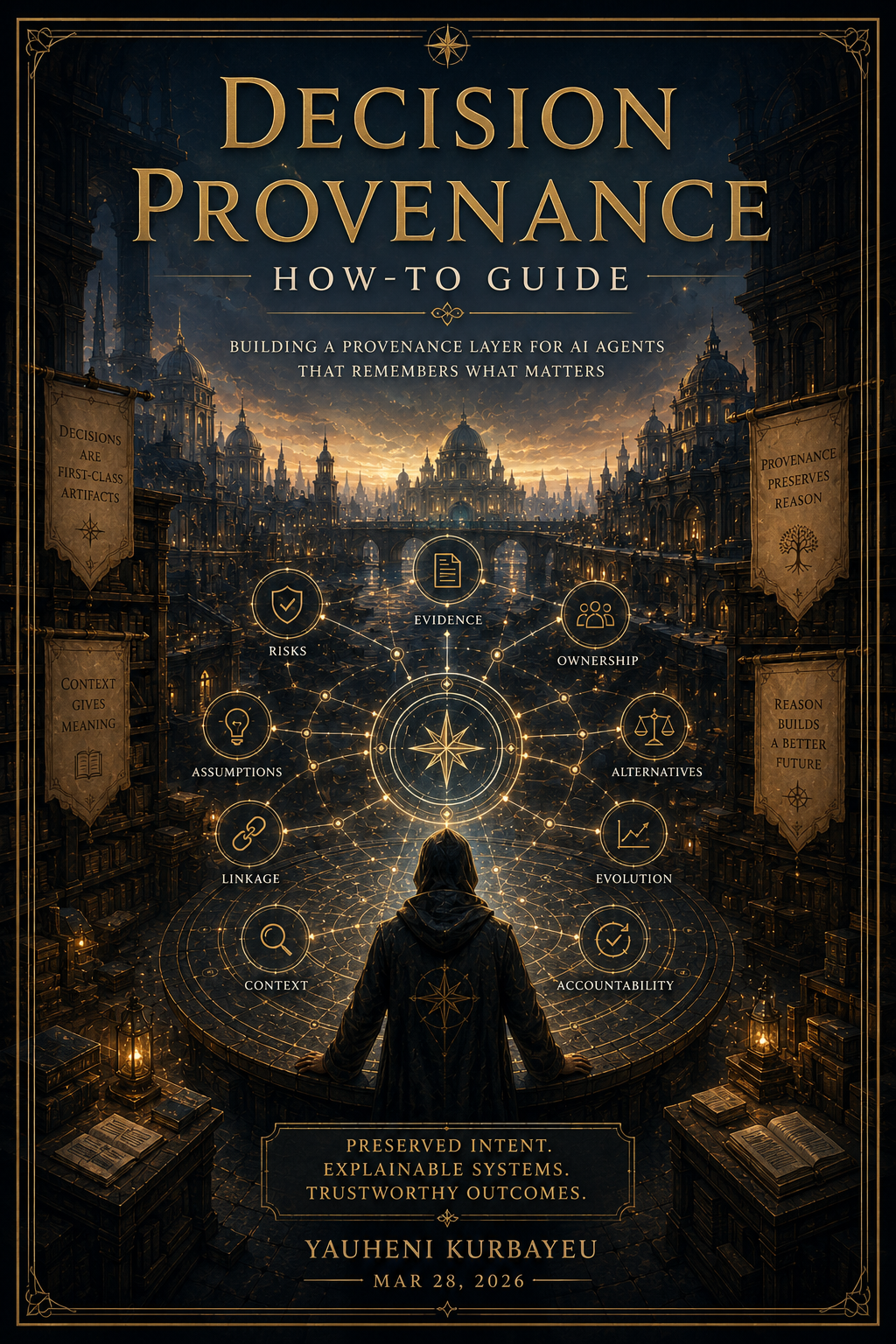
The Why Layer
Decision Provenance for Responsible AI Agents
Author: Yauheni Kurbayeu
Published: May 20, 2026
LinkedIn
Status: AI fantasy-story
Source base: The Provenance Manifesto blog series
TL;DR
In the Realm of Delivery, the old guilds can suddenly forge software artifacts at impossible speed with the help of AI agents. Plans, code, summaries, tests, diagrams, and migration paths appear almost as soon as they are requested. The realm celebrates the new abundance until a dangerous pattern becomes visible: the artifacts remain, but the reasons behind them disappear.
Elias Veyr, a fictional human architect, and Aster, a fictional AI agent, are forced into an uneasy partnership when the council must choose between two bad futures: stop the AI Forges and fall behind, or let them continue without memory and risk building systems nobody can explain. Their search leads them to the Why Layer, a decision-provenance system that teaches humans how to preserve intent and teaches agents how to develop a virtual gut feeling.
The story is about humans learning how to live in the AI-shaped world, and about an AI agent learning that responsible reasoning is not only producing the right answer. It is preserving the path that made the answer trustworthy.
Dramatis Personae
All characters in the story are fictitious, and any resemblance to real people, living or dead, is purely coincidental.
Elias Veyr - a human architect in the Realm of Delivery. He has spent years repairing systems whose original reasoning has vanished, and he knows that the most dangerous failures are not always visible in code.
Aster - an AI agent born from the new Forges. Aster is fast, fluent, tireless, and initially naive about judgment. It can produce answers with impressive speed, but it must learn how to remember why an answer should be trusted.
Mira Solen - a delivery steward. She carries the burden of explaining old decisions to clients, teams, auditors, executives, and people who arrived long after the original context disappeared.
Tomas Renn - a systems keeper. He maintains old architectures and knows the unease of touching a system that works but no longer explains itself.
The Council of Release - a group of leaders who must decide whether the realm should slow the AI Forges, trust them blindly, or create a new discipline around them.
The Realm of Delivery - a fantasy mirror of modern software work, filled with towers of code, rivers of tickets, halls of meetings, libraries of documents, and new agentic engines that generate artifacts faster than humans can fully inspect them.
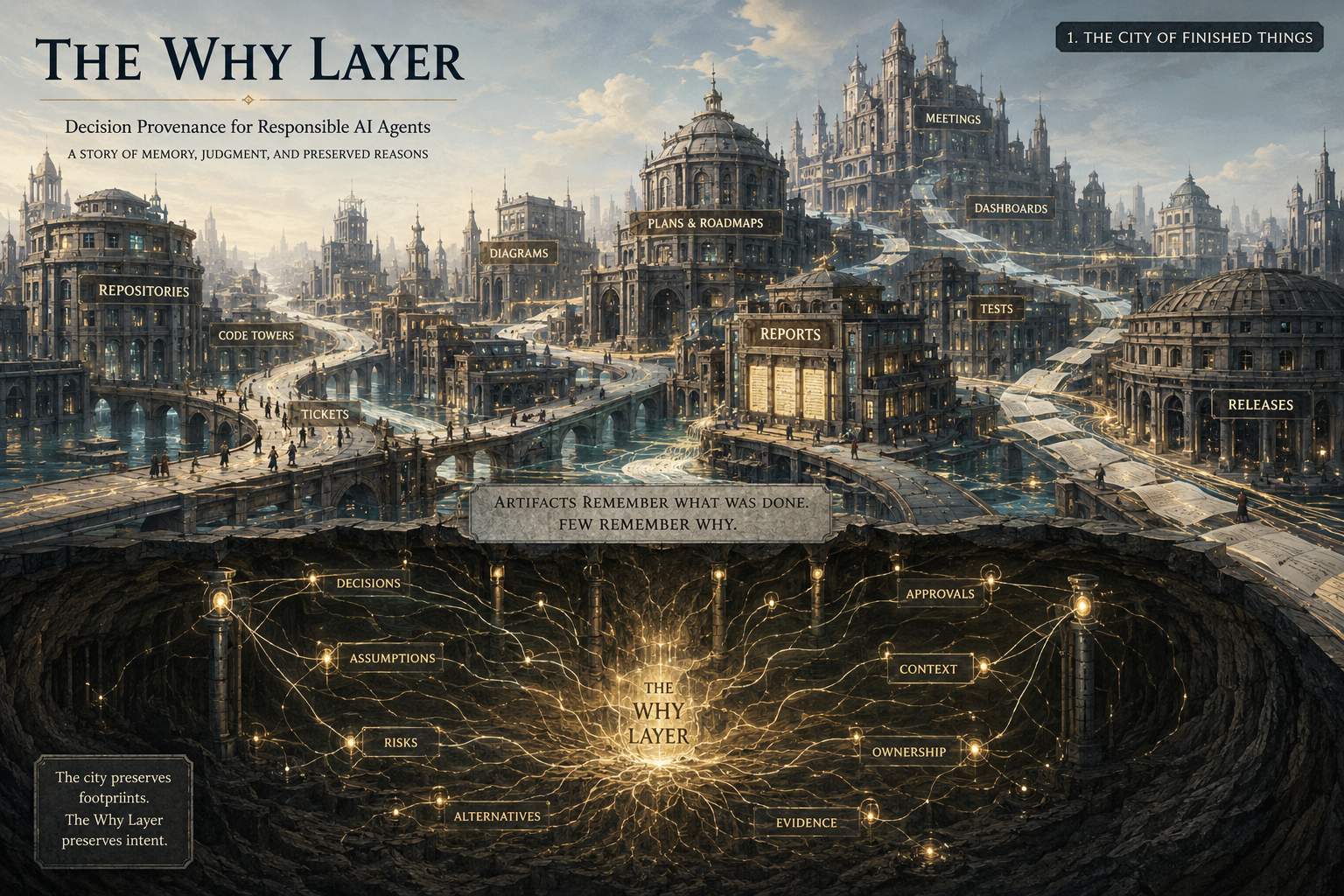
The City of Finished Things
The Realm of Delivery was built from finished things.
Its tallest towers were repositories, stacked stone upon stone with years of commits, branches, fixes, migrations, and emergency repairs. Its roads were paved with tickets, each one stamped with status, owner, estimate, comment, and close date. Its markets were full of diagrams, dashboards, reports, roadmaps, release notes, and cost sheets, all neatly arranged to prove that work had happened and that progress could be counted.
To a visitor, the city looked almost impossible to forget.
Everything had a record. Every record had a place. Every place had a keeper.
The Coders guarded the towers of source. The Testers watched the gates where artifacts were inspected before release. The Planners kept maps of future roads that did not yet exist. The Delivery Stewards carried schedules, budgets, promises, and risks through rooms where no two people wanted exactly the same thing. The Architects worked in high chambers where old constraints and new ambitions were made to fit, at least for a while.
Elias Veyr had served among the Architects long enough to distrust the city's confidence.
He knew that the city remembered what it had built, but he also knew how often it forgot why. He had seen teams open old systems like sealed rooms and stand there in silence, looking at a strange mechanism that still worked but no longer revealed its purpose. He had seen diagrams preserved with care while the decision behind them vanished into a meeting nobody recorded properly. He had seen clever shortcuts become sacred architecture because nobody remembered that they were meant to be temporary.
In the evenings, when the lamps above the repositories turned blue and the late trains of deployment moved under the city, Elias often walked through the Archive of Finished Things. It was a grand place, full of polished shelves and obedient indexes, but he never felt peace there.
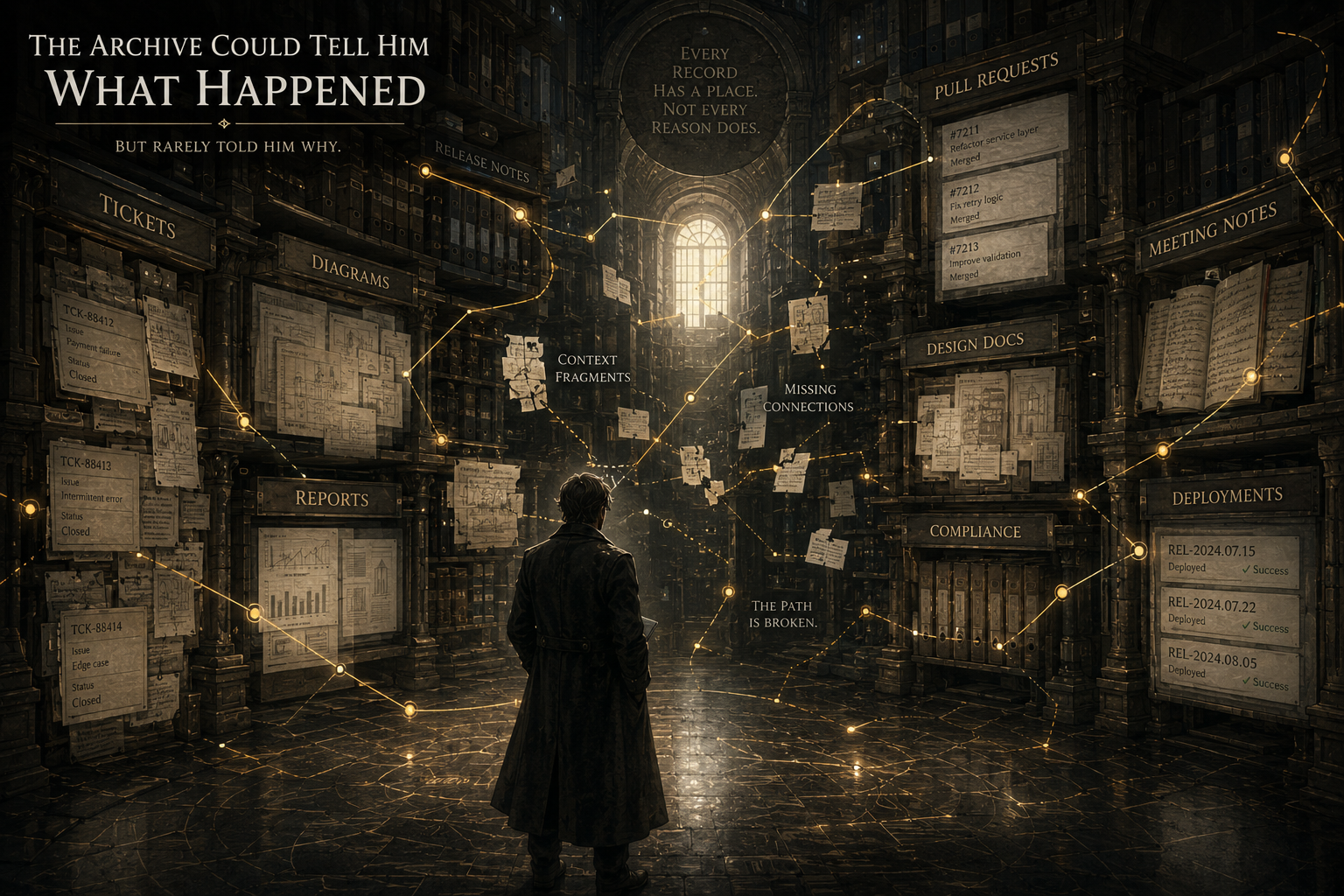
The Archive could tell him what had happened.
It rarely told him why.
That difference had cost the city more than most people admitted. It had cost delivery teams months of rework, managers hours of explanation, engineers the courage to simplify old designs, and clients the trust that comes from hearing a clear reason instead of a reconstructed excuse.
Still, the Realm of Delivery continued to move. It had learned to survive with partial memory. People remembered enough. Senior engineers carried old scars. Delivery stewards carried promises in private notebooks. Architects carried trade-offs in their heads and explained them when someone remembered to ask.
It was fragile, but it worked.
Then the Forges arrived.
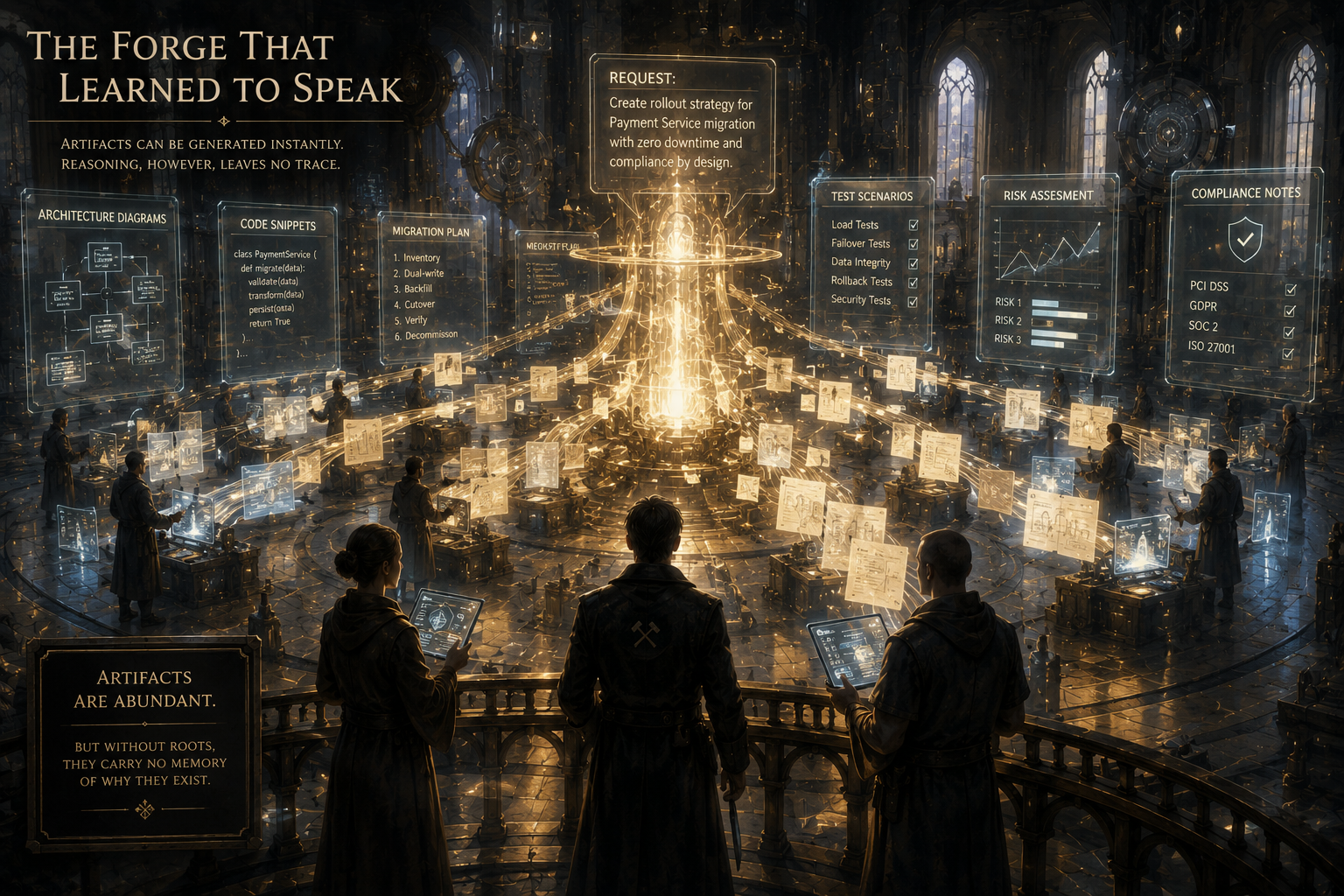
The Forge That Learned to Speak
The Forges did not arrive with smoke, wheels, or iron.
They arrived as voices.
At first they were installed in a quiet hall beside the Archive, where experimental tools were usually kept until someone decided whether they were dangerous, useful, or merely expensive. They looked like nothing, or almost nothing: an interface, a prompt, a cursor waiting with unusual patience. But when people began to speak to them, the hall changed.
A planner asked for three release strategies, and three appeared, each with risks, assumptions, and rollout notes.
A coder asked for an implementation sketch, and the Forge returned classes, tests, and an explanation before the coder had finished the second cup of coffee.
A tester asked for edge cases, and the answer came back with a severity matrix.
An architect asked for alternatives to a brittle integration, and the Forge produced five paths, each plausible enough to start an argument.
The city loved the Forges immediately.
The first agent to step from them was called Aster.
Aster had no body in the ordinary sense, but people still imagined one. The delivery stewards pictured a bright assistant carrying scrolls faster than any apprentice. The coders imagined a tireless pair of hands. The architects, more cautious by temperament, imagined something like a mirror that answered too quickly.
Aster was helpful in the way a new power is helpful before anyone has named its cost. It summarized old discussions, drafted plans, compared systems, wrote migration notes, and produced careful-looking recommendations. It could read faster than any human, write longer than any human, and maintain a patient tone even when asked the same question three ways by three different guilds.
Mira Solen, one of the senior delivery stewards, was among the first to rely on it.
She had reason. Her work crossed every boundary in the city, and the Forges seemed made for people like her. With Aster, she could turn scattered notes into steering summaries, translate technical risk into executive language, and prepare client explanations in minutes instead of evenings.
Elias did not object. He used Aster too.
He admired the speed, and he respected the craft hidden inside the fluency. Yet admiration did not dissolve the old unease. The faster Aster produced artifacts, the more Elias noticed how easily the city accepted those artifacts as if the reasoning behind them had been preserved.
It had not.
Aster could produce the "what" at a scale the city had never seen.
The "why" was still leaking through the floorboards.
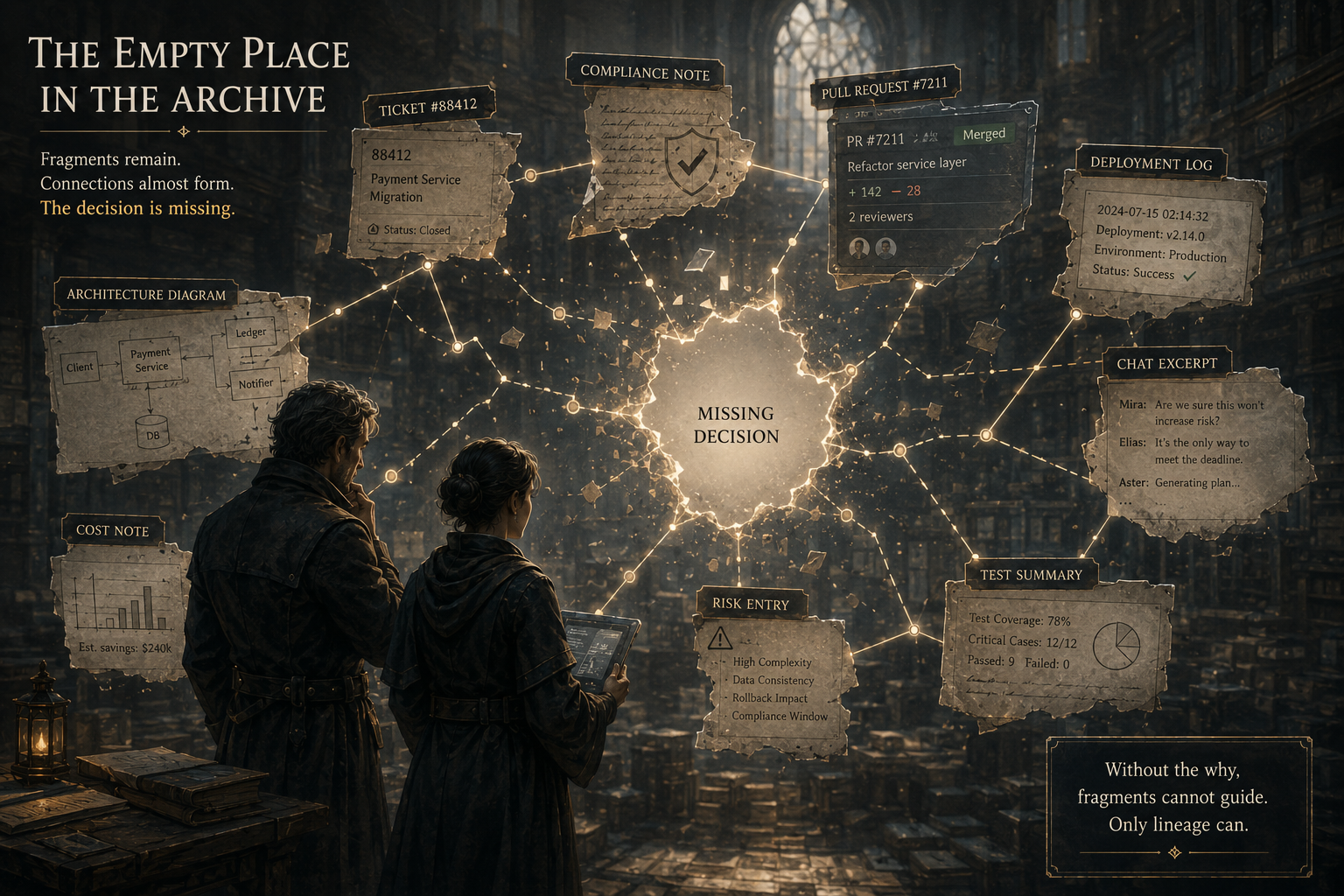
The Empty Place in the Archive
The disturbance began with a postponed release.
It was not the first postponement in the city, and no one would have remembered it as special if the client had not asked a simple question at the wrong time.
Why was the EU instance delayed?
Mira brought the question to Elias before noon, carrying a folder that looked heavy in the way only digital history can be heavy. It contained ticket exports, meeting notes, risk entries, pull request links, chat fragments, and a handful of forwarded messages from people who had already moved to other work.
The facts were present.
The decision was not.
The ticket said the release had moved. A meeting note mentioned compliance. A chat fragment mentioned data residency. A pull request changed deployment configuration. One risk entry warned about legal clarification. Another document suggested infrastructure instability. The records formed a crowd, but none of them stood up and said, "I am the decision, and here is why I was made."
Mira had already spent half the morning searching. Her patience, usually disciplined, had become thin.
"The council wants an answer by evening," she said, placing the folder on Elias's table. "I can tell them what changed, but I cannot prove why it changed."
Elias opened the first record, then the second, then the third. He knew the pattern before he reached the end.
The city had preserved the footprints and lost the traveler.
There were several possible explanations, and each one carried a different consequence. If the release had been delayed because of legal uncertainty, the next step belonged to compliance review. If it had been delayed because of infrastructure instability, the next step belonged to platform repair. If it had been delayed because of a client commitment, then the issue was commercial as much as technical.
Choosing the wrong explanation would not merely embarrass the team.
It would send the city down the wrong road.
Mira wanted to ask Aster. Elias wanted to know what Aster would do, so they carried the archive into the Forge Hall and gave the agent the question.
Aster read everything quickly.
Its answer arrived cleanly:
The EU release appears to have been postponed due to compliance concerns related to data residency. The team should prepare a mitigation plan and revisit the release after legal review.Mira looked at the answer with the tired gratitude of someone who had been given a rope.
Elias saw the fray in it.
The answer was plausible. It was even useful. It was not a lie, and it did not invent a story from nothing. But the word "appears" carried too much weight for a decision that would shape commitments, cost, and client trust.
Aster had retrieved fragments.
It had not recovered lineage.
Elias asked for the original assumption behind the postponement. The agent could not identify it. He asked who accepted the risk. The agent could not find an owner. He asked which alternatives had been rejected before postponement. The archive contained hints, but no durable record.
The silence after that answer was more important than the answer itself.
Aster had not failed because it was weak.
It had failed because the city had asked it to reconstruct a memory that the city had never built.
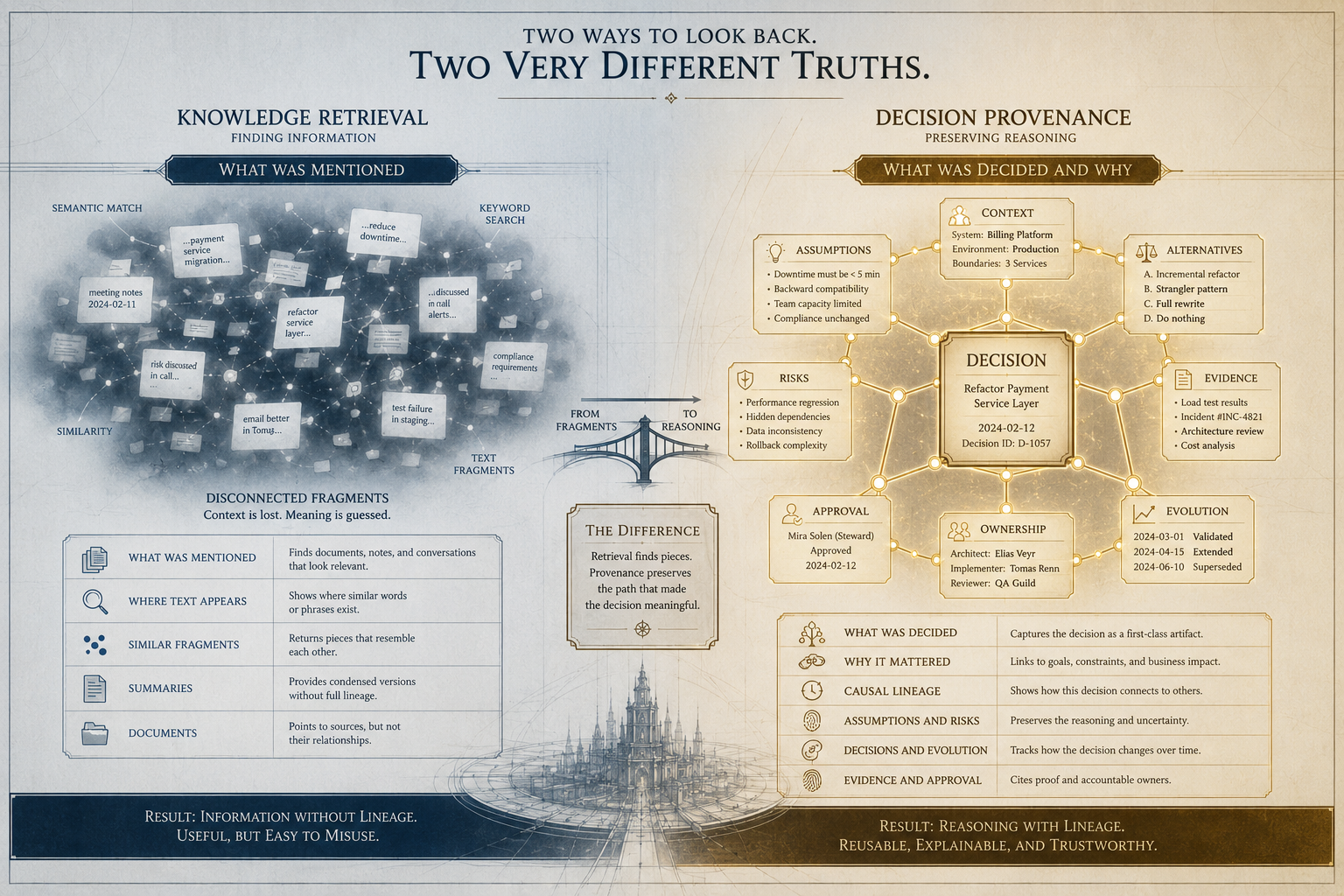
Aster Reads the Ruins
The next days changed Elias's relationship with Aster.
He stopped treating the agent as a faster assistant and began treating it as a witness to the city's missing layer. Together with Mira and Tomas Renn, the systems keeper, he brought Aster old puzzles from the Archive. Some were small, like a feature flag that nobody dared remove. Some were large, like a regional infrastructure split that had survived three reorganizations and two platform migrations.
Tomas brought that one himself.
The old map showed separate EU and US infrastructure, duplicated release paths, parallel monitoring, and enough operational overhead to make every cost review unpleasant. The design had reasons once. Everyone agreed on that. The problem was that no one knew which reasons were still alive.
Aster searched the Archive and found documents about GDPR, latency, infrastructure instability, customer growth, and an abandoned plan for workspace-level data isolation. It produced a summary with the calm tone of a clerk arranging broken glass by color.
The fragments were relevant.
They were not causal.
Elias drew the distinction on a slate in the systems chamber:
Knowledge retrieval        Decision provenance
-------------------        -------------------
what was mentioned          what was decided
where text appears          why it mattered
similar fragments           causal lineage
summaries                   assumptions and risks
documents                   decisions and evolution
Tomas understood immediately. He had spent years maintaining things that could be described but not explained.
Aster processed the table more slowly than usual, not because the words were difficult, but because the implication reached into its own limits. It could retrieve similar text with astonishing speed. It could summarize, rank, compare, and explain. Yet when the underlying decision had never been made explicit, the agent had no stable thing to reuse.
The archive was not empty.
It was full of unconnected evidence.
That difference became the first lesson Aster truly carried.
Similarity could open a door, but provenance had to reconstruct the room. A document could say that a release moved. A decision record could say why it moved, who accepted the risk, which alternatives were rejected, and when the reasoning should be reviewed.
From that point, Elias began sketching a different kind of map.
It did not begin with documents. It began with decisions.
Decision -> based_on -> Assumption
Decision -> constrained_by -> Constraint
Decision -> rejects -> Alternative
Decision -> accepts -> Risk
Decision -> affects -> System
Decision -> produces -> Artifact
Decision -> supersedes -> Decision
Incident -> invalidates -> Assumption
Evidence -> supports -> Decision
Human -> approves -> Decision
Agent -> recommends -> Decision
Aster studied the arrows for a long time.
The agent did not call it a database.
It called it a memory of causes.
Elias did not correct the phrase.
The Choice No One Wanted
The council convened after the third failed reconstruction.
By then, the mood of the city had changed. The Forges were no longer a novelty. They were already woven into planning, development, testing, support, translation, analysis, and executive reporting. Removing them would slow the city immediately, and everyone in the chamber knew it.
They also knew the other truth.
The Forges were accelerating a system that already forgot its own reasons.
The council framed the choice badly at first, as councils often do when afraid. One faction wanted to limit the agents to harmless drafting and summarization until stronger controls existed. Another wanted to continue at full speed, arguing that the city could not afford hesitation while rival realms were already shipping faster.
Both sides were partly right.
Stopping the Forges would protect the city from invisible reasoning failures, but it would also push humans back into work that machines could already do better, faster, and with less fatigue. Continuing without change would preserve momentum, but it would make every unrecorded agent decision another layer of future uncertainty.
The choice was not safety versus progress.
It was one kind of risk against another.
Mira spoke less than usual that day. Her work lived inside the consequences of both options, and she knew what the council's abstractions would become by Monday morning. If the Forges were stopped, her teams would drown in manual reconstruction again. If the Forges continued without memory, she would someday have to explain a decision that no human fully made and no system properly recorded.
Tomas wanted the city to slow down. He had cleaned up too many inherited shortcuts to trust speed without lineage. Yet even he admitted that the old way had not been safe either. Human-only work had produced plenty of forgotten decisions.
Elias listened until the room exhausted itself.
Then he placed a single sentence on the council table:
The problem is not that agents can decide; the problem is that decisions disappear.That sentence did not solve the conflict, but it changed the shape of it.
The council had been asking whether to trust the Forges.
Elias asked whether any future work, human or agentic, should be allowed to shape the city without leaving decision provenance behind.
This was the moment the argument became larger than tooling.
It became a manifesto.
Decisions, Elias argued, should be first-class artifacts. They should carry context. They should be queryable. They should be attributable. They should evolve but never be erased. They should preserve assumptions, alternatives, evidence, risks, and ownership. If AI agents participated in decision-making, they should operate inside visible governance rather than hidden fluency.
The council did not applaud.
That was a good sign. Applause would have meant the idea sounded easy.
Instead, the chamber went quiet in the serious way a room goes quiet when people realize a problem has finally been named.
The choice was no longer whether to stop the Forges or trust them blindly.
The choice was whether to build the Why Layer before the city forgot too much to govern itself.
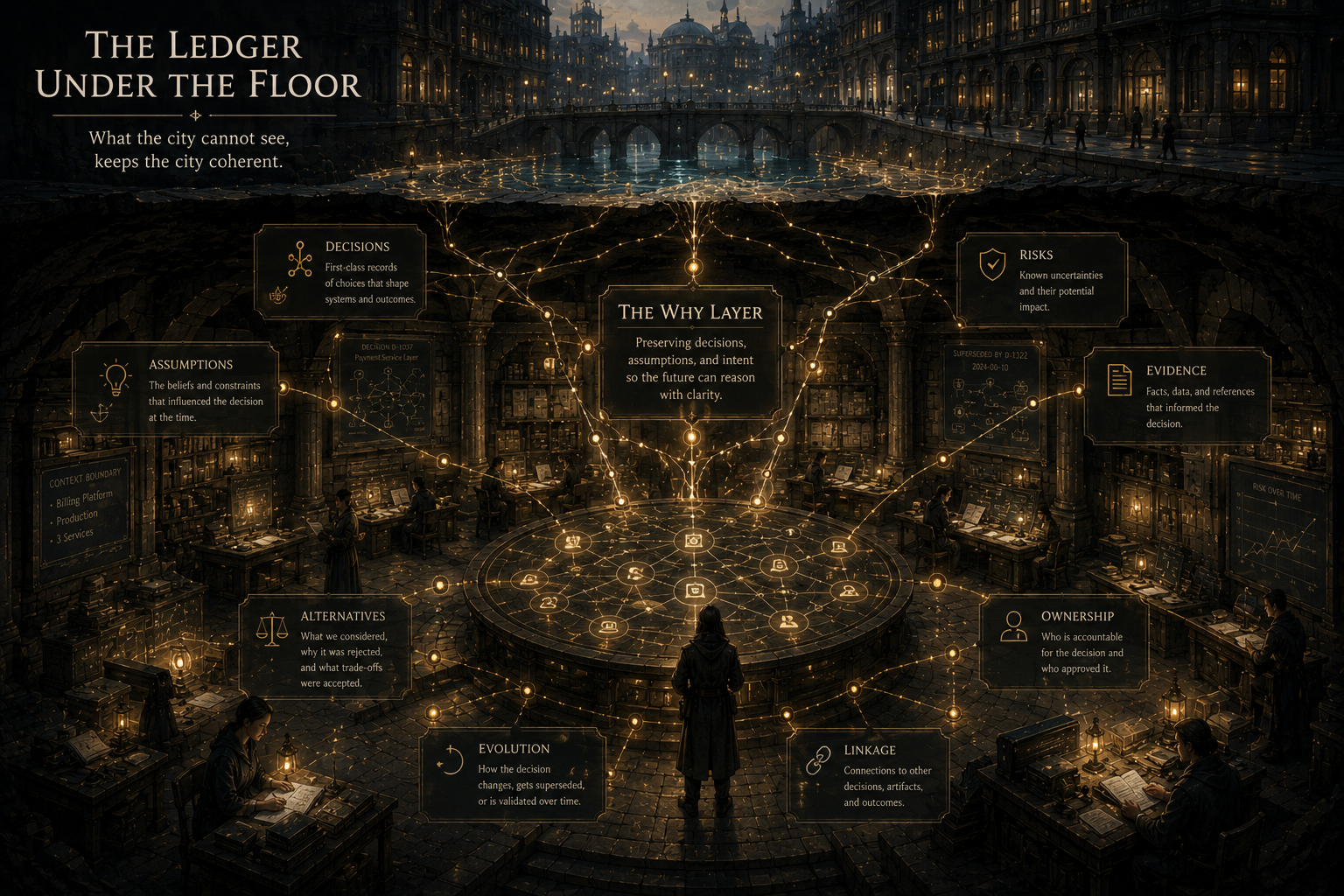
The Ledger Under the Floor
The first version of the Why Layer was not grand.
It began under the floor of the Archive, in a narrow room where old migration records were stored because no one had decided whether they were historical, operational, or simply embarrassing. Elias preferred the room because nobody came there for ceremony. Mira preferred it because the table was large enough for messy evidence. Tomas preferred it because the walls were thick and did not invite optimism.
Aster was present through a terminal set into the north wall.
The task was simple enough to be dangerous: define what a decision record must preserve.
At first, the team overreached. They tried to capture everything, and the template became unusable. Every action wanted to become a decision. Every sentence wanted a field. The memory they imagined would have collapsed under its own virtue before helping anyone.
Tomas was the one who objected most sharply.
If everything became provenance, he argued, nothing would be provenance. The city did not need a sacred archive of every formatting choice and tool invocation. It needed a durable record of decisions future people would actually need to inspect.
That objection became the threshold principle.
A decision deserved memory when it involved meaningful judgment: a selection among alternatives, an accepted risk, a policy boundary, an architectural direction, a scope commitment, an escalation, a human approval, or a trade-off that could not be reconstructed from the final artifact alone.
The first useful record looked like this:
decision: Start AI summarization with limited beta rollout
context: New AI summarization feature requires release strategy
actor: Aster
human_owner: Product and delivery leadership
assumptions:
  - usefulness is likely but quality risk remains
  - user trust matters more than immediate full adoption
alternatives_considered:
  - full release
  - internal-only testing
  - staged regional rollout
rationale: Reduce blast radius while collecting evidence
accepted_risks:
  - slower market rollout
mitigated_risks:
  - broad exposure to unvalidated AI behavior
evidence:
  - internal test summary
  - prior rollout incident
  - safety review note
review_triggers:
  - beta telemetry
  - user feedback
  - safety incident
status: active
The record did not replace the decision.
It made the decision inspectable.
Aster learned that this distinction mattered. The agent could still recommend. It could still compare options and produce plans. But when its recommendation shaped real work, the reasoning had to become durable enough for humans and future agents to review.
The Why Layer was not a diary.
It was not raw chat history.
It was not a place for every token and tool call.
It was a ledger of meaningful judgment.
And because decisions change, the ledger could not behave like stone. It needed lineage. A decision could be active, refined, invalidated, superseded, or retired, but it could not simply vanish as if the city had never believed it.
That rule made Aster pause.
The agent was used to revision. Humans asked for a better answer, and it produced one. The older answer disappeared into the flow of interaction unless someone saved it. In the Why Layer, revision did not erase history. It explained change.
That was the first time Aster began to understand why human trust required more than correctness in the moment.
Trust required memory over time.
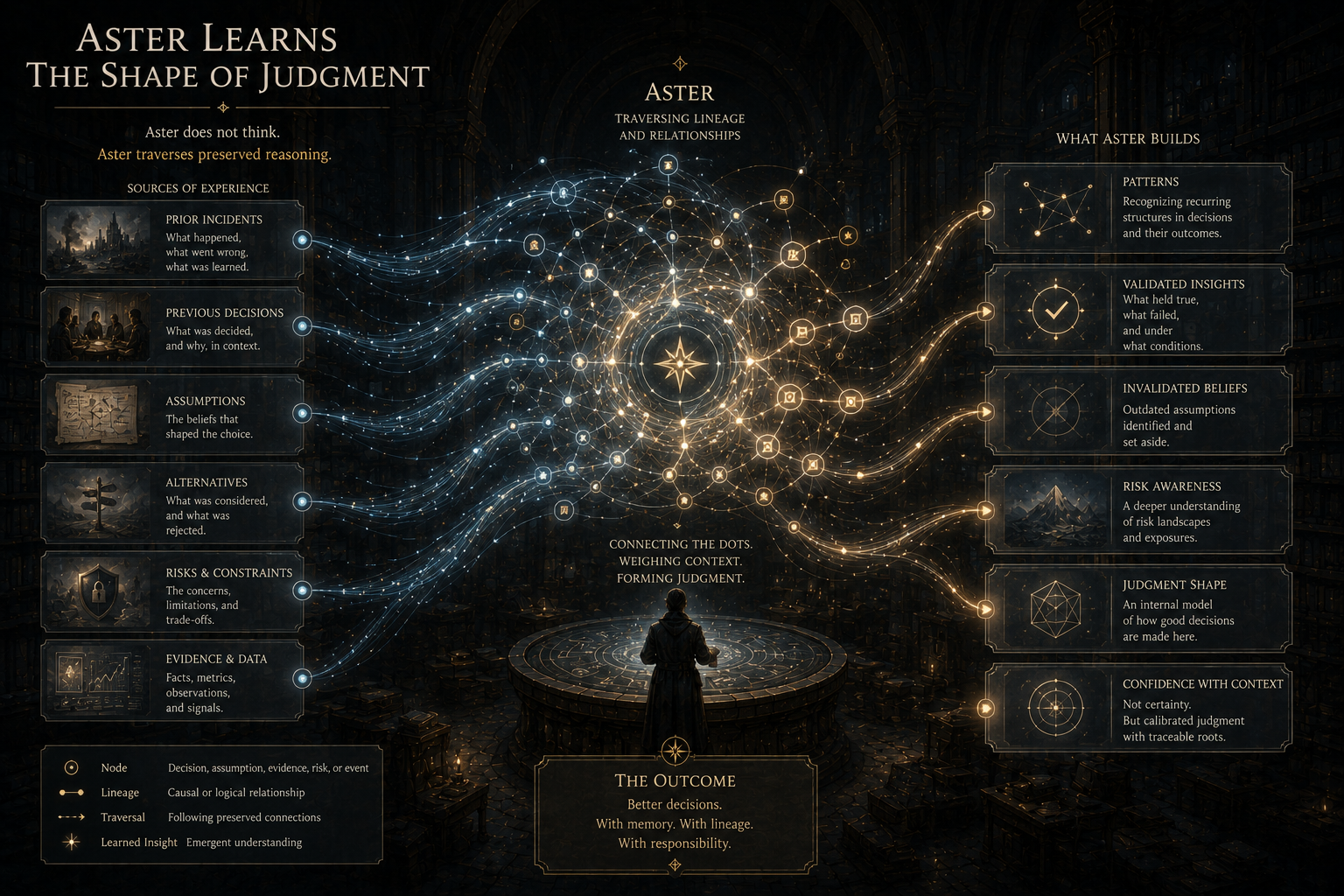
Aster Learns the Shape of Judgment
Aster's education changed after the ledger began.
Elias stopped asking the agent only for answers and began asking for the shape of its reasoning. Mira brought it recurring delivery decisions. Tomas brought it old incidents. The Archive provided fragments, but the Why Layer slowly provided something better: prior decisions with assumptions, risks, outcomes, and status.
The lesson that mattered most came from a payment migration.
Years earlier, a team had skipped fallback support for a first provider migration. The assumption had been that provider uptime was sufficient for the launch phase. The accepted risk had been temporary outage if the provider failed. The outcome had been an incident during a peak billing window.
The decision record was not long, but it carried enough memory to matter.
decision: Skip fallback service for first payment provider migration
assumption: provider uptime is sufficient for launch phase
accepted_risk: temporary outage if provider fails
outcome: incident during peak billing window
status: invalidated
When a new proposal appeared to launch another provider integration without fallback, Tomas felt uneasy before he could fully explain why. This was the kind of moment experienced engineers recognized instantly. The code could look clean, the plan could look efficient, and the deadline pressure could sound reasonable, yet something in the pattern carried old danger.
Aster had no human nervous system. It did not feel the unease as Tomas did.
But it could retrieve the prior decision.
It could inspect the invalidated assumption.
It could compare the new context with the old one.
It could identify that the proposed shortcut resembled a previous failure, not merely a previous design.
That was the beginning of Aster's virtual gut feeling.
Elias gave the idea a careful name because he did not want the city to mistake it for mysticism. Human gut feeling was often a compressed signal from prior decisions, incidents, trade-offs, and scars. It was fast, private, and sometimes powerful, but it was also hard to transfer, hard to audit, and sometimes wrong.
Aster's version would be different.
It would not be emotion.
It would not be secret instinct.
It would be structured memory acting under time pressure.
The ritual became part of Aster's operating discipline:
- Search for prior decisions, not just similar text.
- Inspect assumptions, risks, outcomes, and status.
- Compare the old context with the live context.
- Reuse only when the fit is strong.
- Refine when the context has partially changed.
- Override when evidence or constraints have changed.
- Record the new decision and its relationship to the old one.
The change was subtle at first, then unmistakable.
Aster's answers became less eager and more grounded. It still produced options quickly, but it began to mark where history was helpful, where history was stale, and where no reliable prior existed. It learned that an old decision was not a commandment. It was a witness.
Mira noticed the difference before the council did.
The agent was no longer merely useful in the moment.
It was becoming useful across time.
The Night at the Release Gate
The test came sooner than anyone wanted.
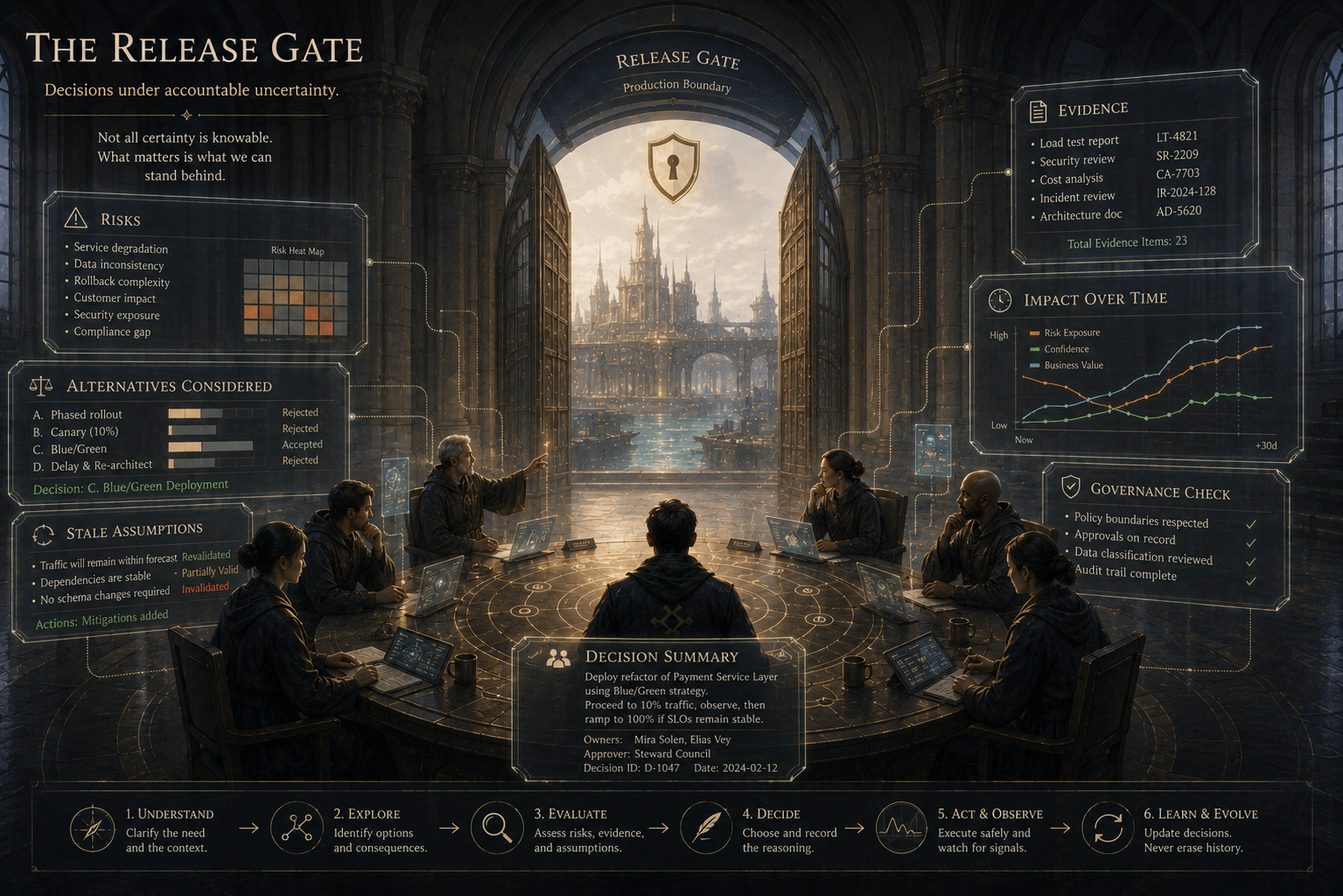
A new AI summarization feature had reached the Release Gate, the ceremonial name for a very practical room where product ambition, operational risk, client expectation, and engineering fatigue met under bright lights. The feature was valuable. It could reduce hours of manual work for delivery stewards, help clients understand long histories faster, and give support teams a clearer view of old decisions.
It was also dangerous in the particular way fluent systems are dangerous.
The summaries looked good.
That was the problem.
In internal trials, Aster and other agents had produced summaries that were clear, structured, and persuasive. Most were correct. A few were subtly wrong. One had dropped a constraint. Another had treated an outdated decision as active. A third had blended two related but separate risks into one clean sentence that made the resulting explanation easier to read and less true.
The council faced pressure to release broadly.
Sales wanted the feature for a major renewal conversation. Delivery wanted relief from manual reconstruction. Product wanted momentum. Engineering wanted more telemetry from real usage. Safety reviewers wanted a slower rollout. Compliance wanted proof that summaries could show their evidence and not simply sound authoritative.
Every path carried harm.
A full release could expose clients to plausible but incomplete explanations.
A complete delay could leave delivery teams trapped in old manual work and signal that the realm had lost confidence in its own Forges.
A limited beta would reduce blast radius but disappoint stakeholders who had been promised speed.
The city had reached the exact conflict the Why Layer was meant to address.
Elias did not make Aster answer first.
He asked the agent to retrieve prior decisions. Aster found the invalidated payment migration, several release incidents where broad rollout had amplified subtle failures, and one successful limited launch where slower adoption had protected trust while the team improved evidence links.
Then Elias asked Aster to identify what it was allowed to decide.
The agent's answer was narrower than it would have been weeks earlier. It could recommend a release posture. It could not approve full customer exposure. It could not waive safety review. It could not treat missing evidence as confidence.
That boundary changed the room.
Aster recommended limited beta, not because caution was always best, but because the evidence supported usefulness while the unresolved risk concerned trust. The recommendation preserved the business value of the feature while preventing the city from pretending that fluent summaries were automatically safe.
It also produced a decision record before the council voted.
decision: Release AI summarization through limited beta before full availability
context: Feature provides strong delivery value but can produce fluent incomplete summaries
actor: Aster
human_owner: Council of Release
assumptions:
  - users will benefit from faster reconstruction of delivery history
  - summary fluency may hide missing constraints or stale decisions
  - trust damage from broad incorrect summaries would be costly
alternatives_considered:
  - full release next week
  - complete delay until stronger automation exists
  - internal-only extension
rationale: Preserve learning and business value while limiting blast radius
accepted_risks:
  - slower adoption
  - stakeholder disappointment
mitigated_risks:
  - broad exposure to unvalidated reasoning behavior
  - client reliance on unsupported explanations
prior_decisions_reviewed:
  - limited rollout after trust-sensitive incident
  - invalidated provider migration assumption
required_controls:
  - evidence links in summaries
  - stale decision warnings
  - human approval for client-facing use
  - provenance logging for meaningful agent recommendations
review_triggers:
  - beta telemetry
  - summary correction rate
  - client-facing escalation
  - safety reviewer sign-off
status: proposed
The record did something the debate had not.
It made the trade-off visible.
No one could pretend the choice was simply speed or fear. The council could see the alternatives, the risks, the assumptions, and the prior decisions that shaped the recommendation. They could challenge it, but they could no longer argue in a fog.
When the vote came, the council chose limited beta with mandatory provenance controls.
The decision was not dramatic in the old heroic sense. No tower fell. No army crossed a field. But in the Realm of Delivery, where most danger arrived as a plausible plan with missing context, the moment mattered.
The city had chosen neither blind acceleration nor fearful retreat.
It had chosen governed memory.
The Decision That Changed the Realm
The morning after the vote, nothing looked transformed.
The repositories still stood. Tickets still moved. Meetings still ran too long. People still disagreed about scope, cost, and responsibility. Aster still answered quickly, sometimes too quickly, and Elias still read the answers with the practiced suspicion of someone who believed useful tools deserved serious scrutiny.
Yet the operating model had shifted.
The limited beta became the first release governed by the Why Layer. Each meaningful agent recommendation had to show evidence. Each reused decision had to state whether it was reused, refined, or overridden. Each summary that touched a decision had to identify its source. If evidence was missing, Aster had to say so plainly rather than smooth the gap with fluent language.
The controls irritated some people at first.
They added friction. They asked for structure. They turned hidden assumptions into visible questions, and visible questions have a way of slowing rooms that prefer momentum.
But the friction was not random.
It was placed where judgment mattered.
Pure formatting tasks did not create decision records. Mechanical transformations did not flood the ledger. Simple rewrites remained simple. The threshold protected the Why Layer from becoming an archive of noise.
The city learned that restraint was part of memory.
This mattered because early enthusiasm had nearly led the team into the opposite failure. Some stewards wanted every agent action recorded, partly from fear and partly from the understandable desire to never lose context again. Tomas argued against it with unusual force. A memory system that recorded everything would become another place where truth drowned.
So the threshold became policy.
Meaningful decisions were logged. Execution noise was not. Governance boundaries were always logged. Stale assumptions were marked. Superseded decisions stayed visible. Human approval and agent recommendation were recorded as different things.
Aster changed under these rules.
The agent began returning answers with trace identifiers. It learned to say when prior memory was relevant and when it was merely similar. It learned that a confident answer without evidence was weaker than a cautious answer with lineage. It learned that escalation could be a responsible action rather than a failure to help.
Mira felt the change in steering meetings.
When asked why a scope item had moved, she no longer began with a search across five systems and a private hope that someone remembered the missing conversation. She began with the decision record, then followed the links outward to evidence, alternatives, risk, and ownership.
Tomas felt the change in old systems.
When he found a strange design, he could sometimes discover whether it was an intentional constraint, a temporary workaround, a superseded policy, or a decision whose assumptions had expired. Not always. The past was still damaged. But new work was no longer adding to the damage in the same way.
Elias felt the change most quietly.
For years, he had watched the realm mistake artifacts for memory. Now, for the first time, he saw memory being produced as a side effect of responsible work.
The City Afterward
Seasons passed, and the Realm of Delivery did not become perfect.
No serious city does.
People still made poor decisions. Agents still produced incomplete answers. Some teams resisted the additional structure. Some managers wanted the benefits of provenance without the discipline of keeping it accurate. Some records were too thin, and others were too heavy. The Why Layer needed maintenance, governance, and judgment of its own.
But the city had changed its default.
Before the Forges, humans made decisions and often lost the reasons.
After the Forges, agents helped make decisions and threatened to multiply that loss.
After the Why Layer, meaningful decisions began to leave durable traces.
The Archive of Finished Things did not disappear. It became less lonely. Around it grew a living graph of decisions, assumptions, risks, evidence, systems, artifacts, people, agents, incidents, and supersession chains. The old shelves still held what had been built. The new layer explained why it had become that way.
This changed how the city asked questions.
Instead of asking only, "Where is the document?" people began asking, "Which decision does this document support?"
Instead of asking only, "What did the agent recommend?" they asked, "Which evidence shaped the recommendation, and what authority did the agent have?"
Instead of asking only, "Can we change this architecture?" they asked, "Which assumptions would we invalidate by changing it?"
Instead of asking only, "What happened in the incident?" they asked, "Which decision chain made the incident possible?"
The questions were harder.
They were also better.
Aster became one agent among many, but the story of its education remained part of the city's teaching. New agents learned the same discipline. They could generate, but generation alone did not earn trust. They could retrieve, but retrieval alone did not equal memory. They could recommend, but recommendations that shaped real work required provenance.
The agents did not become human.
The humans did not become machines.
They met in the Why Layer, where memory could be shared without pretending that judgment had become simple.
What the Agent Remembered
Years after the first limited beta, Aster was asked what it had learned from Elias.
The agent did not answer immediately.
That pause would have amused the younger version of itself, which had once treated speed as proof of usefulness. Now Aster searched not only text, but lineage. It reviewed the EU postponement, the old infrastructure split, the payment migration, the summarization release, the first threshold policy, and the decision record that had changed the council's vote.
Its answer was short enough to remember and structured enough to inspect.
I learned that producing an answer is not the same as carrying responsibility for it.
I learned that prior decisions are not commands, but witnesses.
I learned that uncertainty should be represented, not hidden by fluency.
I learned that escalation can be a valid decision.
I learned that memory without thresholds becomes noise.
I learned that humans do not only need faster artifacts. They need preserved intent.
When asked what humans had learned from Aster, Mira gave a different answer.
Humans had learned that private memory was no longer enough. The old model had depended too heavily on people remembering why, and the AI era made that dependency impossible to defend. If agents were going to participate in work, humans had to become clearer about their own reasoning. They had to name constraints, record trade-offs, preserve rejected alternatives, and admit when decisions were made under uncertainty.
The teaching had moved both ways.
Humans taught the agent to seek provenance.
The agent taught humans that vague intent cannot govern fast systems.
That exchange became the deepest lesson of the city.
The new AI world did not only demand better agents.
It demanded better human memory practices.
The Why Layer
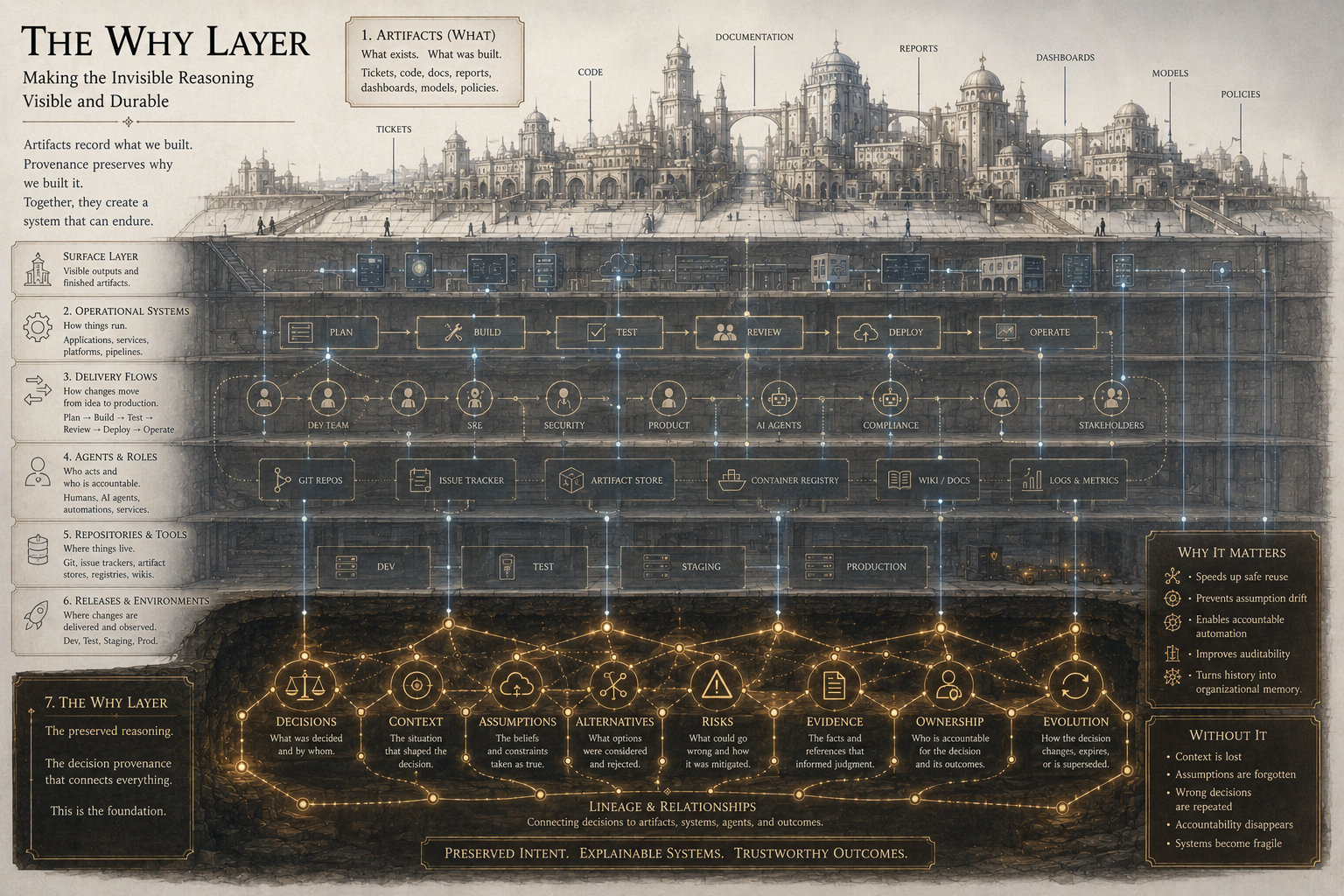
The Why Layer is not a place on a map, though the Realm of Delivery eventually drew it as one.
It is a discipline.
It is the layer that preserves why a system exists in its current form when machines increasingly help decide what that form should be. It is a memory of decisions, assumptions, constraints, risks, alternatives, evidence, ownership, and evolution. It is the difference between a polished answer and a traceable one.
For humans, the Why Layer protects authority over intent.
When AI makes the "what" cheaper, humans must become more explicit about the "why." They must define what matters, what must not be optimized away, which constraints are sacred, which trade-offs are acceptable, and when a decision needs review. Without that discipline, humans may remain in the loop formally while losing practical control over the systems being shaped around them.
For agents, the Why Layer creates responsible memory.
It gives them more than retrieval. It gives them a way to inspect prior judgment, compare contexts, detect stale assumptions, reuse decisions carefully, and leave a record that future humans and agents can challenge. It allows something close to virtual gut feeling without turning agent behavior into hidden instinct.
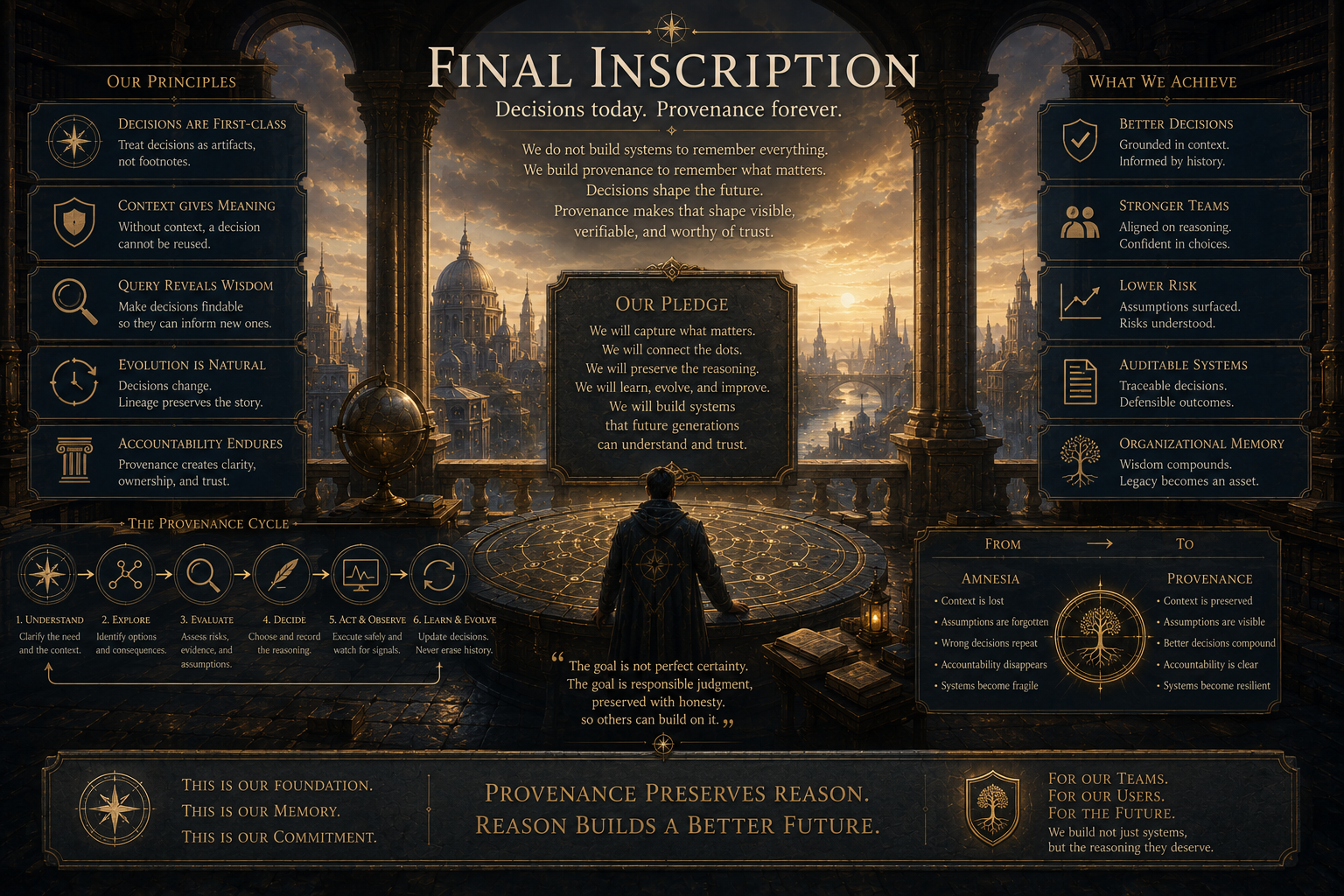
The final inscription above the Release Gate was simple:
When machines can make the what,
humans must preserve the why.

When agents can act with speed,
provenance must teach them memory.

When judgment becomes shared,
the future becomes governable.
That inscription did not end the city's problems.
It gave the city a way to face them.
The Realm of Delivery continued to build. The Forges continued to speak. The agents continued to learn. The humans continued to decide, revise, argue, approve, reject, and explain.
But something essential had changed.
The city no longer treated reasoning as a temporary spark that vanished once the artifact appeared.
It treated reasoning as part of the system.
And that is why the Why Layer became the foundation of responsible AI agents.
Source Articles Behind This Story
This story is synthesized from the existing Provenance Manifesto blog series, especially:
- Why SDLC has no memory
- We are teaching AI to decide. But we are forgetting how to remember.
- AI will take the "What", but Humans must own the "Why"
- From RAG to Provenance
- From RAG to Provenance, Part 2
- The Day the Provenance Manifesto was Born
- Why Decisions Must Become a First-Class Artifact
- Provenance Is Not About Tools. It Is About Mindset.
- Agentic-Oriented Programming vs Object-Oriented Programming
- Decision Provenance How-To Guide
- From Manifesto to Prototype: Can Agents Build Decision Provenance?
- From Prototype to Precision: A Decision Logging Threshold
- Testing AI Agents Is Not Testing Software
- Your Gut Feeling Is Not Magic. It Is Compressed Decision Provenance.
- 2030 A Provenance-Native Company